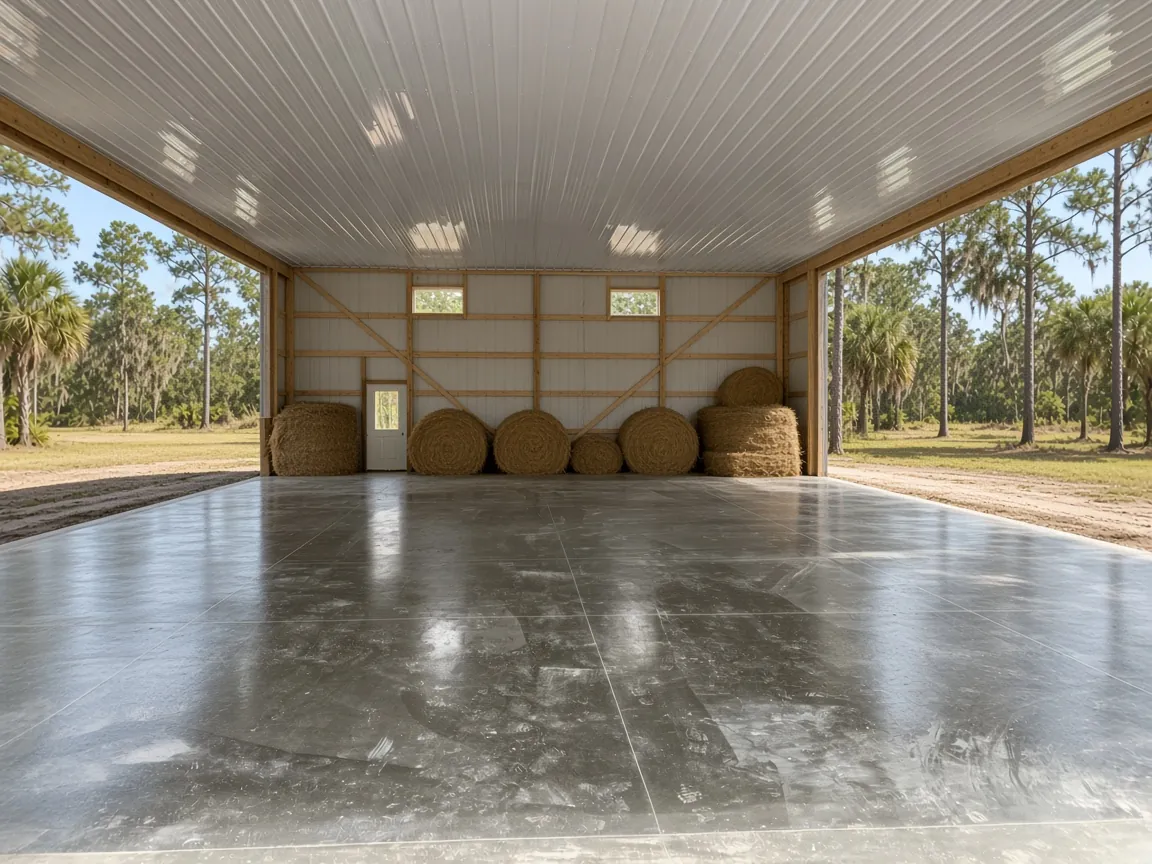
What s. 604.50 exempts, in the statute's own words
Florida Statute 604.50 says any nonresidential farm building, farm fence or farm sign located on lands used for bona fide agricultural purposes, not including urban agriculture, is exempt from the Florida Building Code and any county or municipal code or fee. The one carve-out is code provisions that carry out local, state or federal floodplain management rules. A second statute, s. 553.73(10)(c), independently lists nonresidential farm buildings on farms among the structures the building code does not reach.
That's a broad exemption, and a narrow one. It covers a barn, a hay shed or an equipment building that is truly used for farming. It does not cover a house, a shop that is not used primarily for agriculture, or a barn that is farm-shaped only on paper.
If you are planning a working barn, read this page first, then see our pole barn slab page for the floor, or ask for a free estimate once you know which permit path you're on.
Three tests your building has to pass
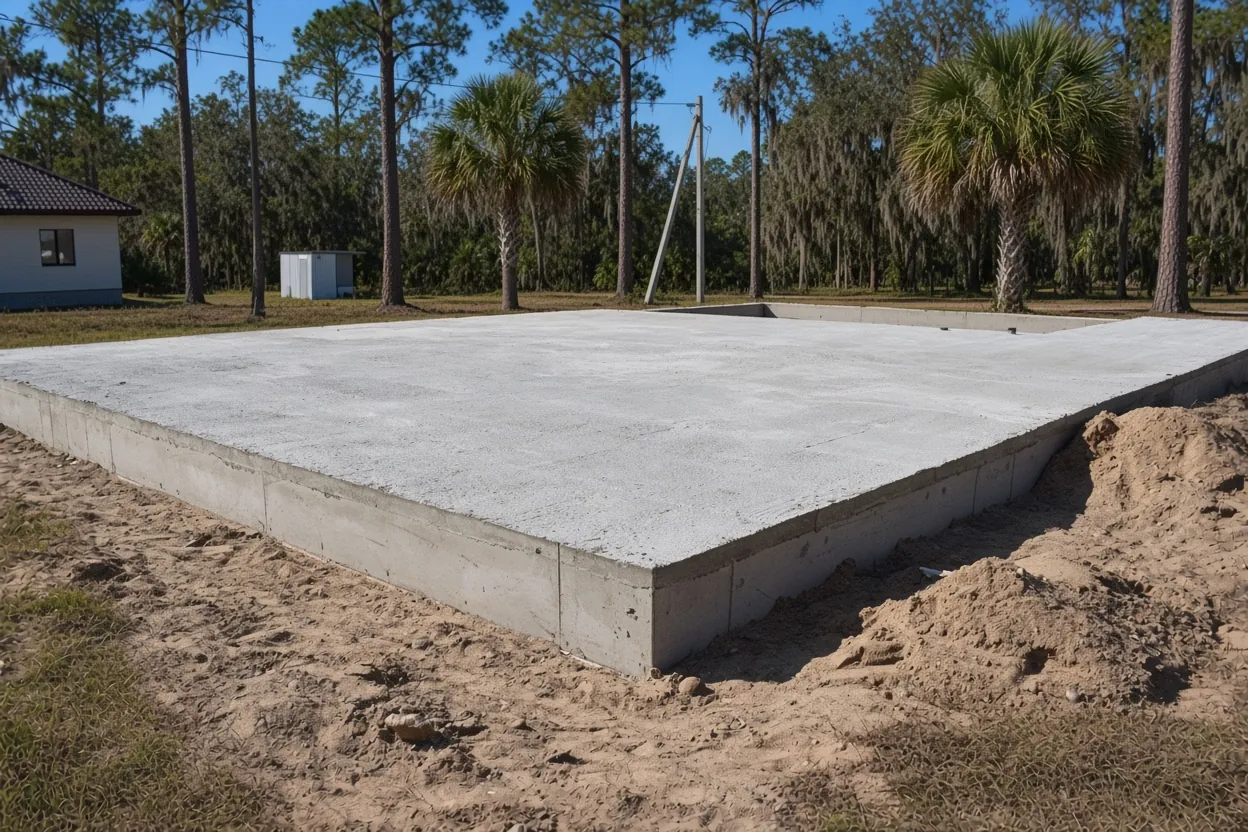
Read the definition in s. 604.50(2)(d) slowly. A nonresidential farm building is a temporary or permanent building or support structure that sits on a farm, is used primarily for agricultural purposes, and is not intended as a residential dwelling. The statute says the term may include a barn, greenhouse, shade house, farm office, storage building or poultry house.
- It is not a dwelling. It is not intended to be lived in.
- It is used primarily for agriculture. Hay, feed, equipment, livestock, crops. If the main use is something else, the building fails this test.
- The land qualifies. The building has to sit on land that is an integral part of a farm operation, or that is classified as agricultural land. Urban agriculture is excluded.
The statute defines a farm, through s. 823.14, as the land, buildings, support facilities, machinery and other appurtenances used in producing farm or aquaculture products. A building that supports that work belongs on the farm. A building that supports a hobby may not. With 2,197 farms counted in Polk in the 2022 Census of Agriculture, the question is a live one here, and the answer always depends on your parcel and your use.
What It Costs
Our typical Polk County ranges for the floors under working farm buildings.
| Slab | Per sq ft | Typical project | What it covers |
|---|---|---|---|
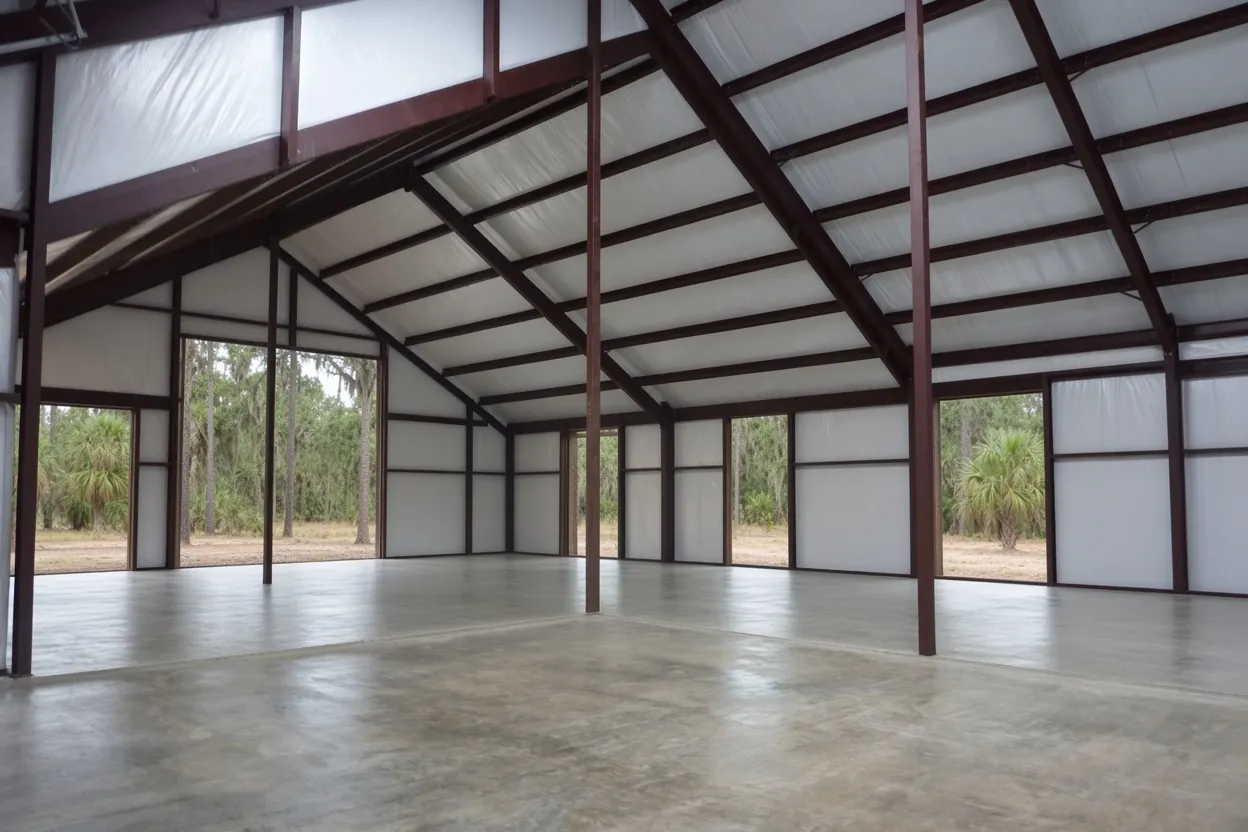
| Agricultural and equipment slab | $6 to $11 | $6,000 to $40,000+ | Equipment sheds, hay barns, feed and wash pads, machinery floors |
| Pole barn slab | $7 to $12 | $8,500 to $15,000 | 30x40, reinforced 4 to 6 in., before or after the frame |
| Horse barn slab | $7 to $13 | $8,000 to $35,000 | Aisles, wash racks, tack and feed rooms |
What agricultural classification means, and what the appraiser looks at
A tax bill isn't the whole test. Classification is only one of two ways to show the land qualifies. Still, classification is the easiest paper trail to hand a building office, so it is worth understanding.
Under s. 193.461, the county property appraiser classifies as agricultural only land used primarily for bona fide agricultural purposes, defined as good-faith commercial agricultural use of the land. The appraiser weighs how long the land has been used this way, whether the use is continuous, what was paid for the parcel, how large the parcel is compared with the use, and whether the land is cared for in line with accepted commercial practices. An agricultural classification return is due March 1 each year.
What that means for a barn: a few acres of pasture with no commercial use may not pass. A cattle operation, hay fields or a grove with real production may. Your barn is judged on your land, not on the county's farming reputation. If the parcel is not classified, ask the building office what else it will accept as proof of a farm operation.
How the Job Goes
Confirm the land and the use
Check agricultural classification or farm operation, and that nobody will live in the building.
Call the right office
The Polk County Building Division, or your city's building office if the parcel is inside city limits.
Get the path in writing
Affidavit, plans, site plan, setbacks and any floodplain rules, confirmed before you buy materials.
Free on-site estimate
We walk the pad and your drawing, then send a written quote within 48 hours.
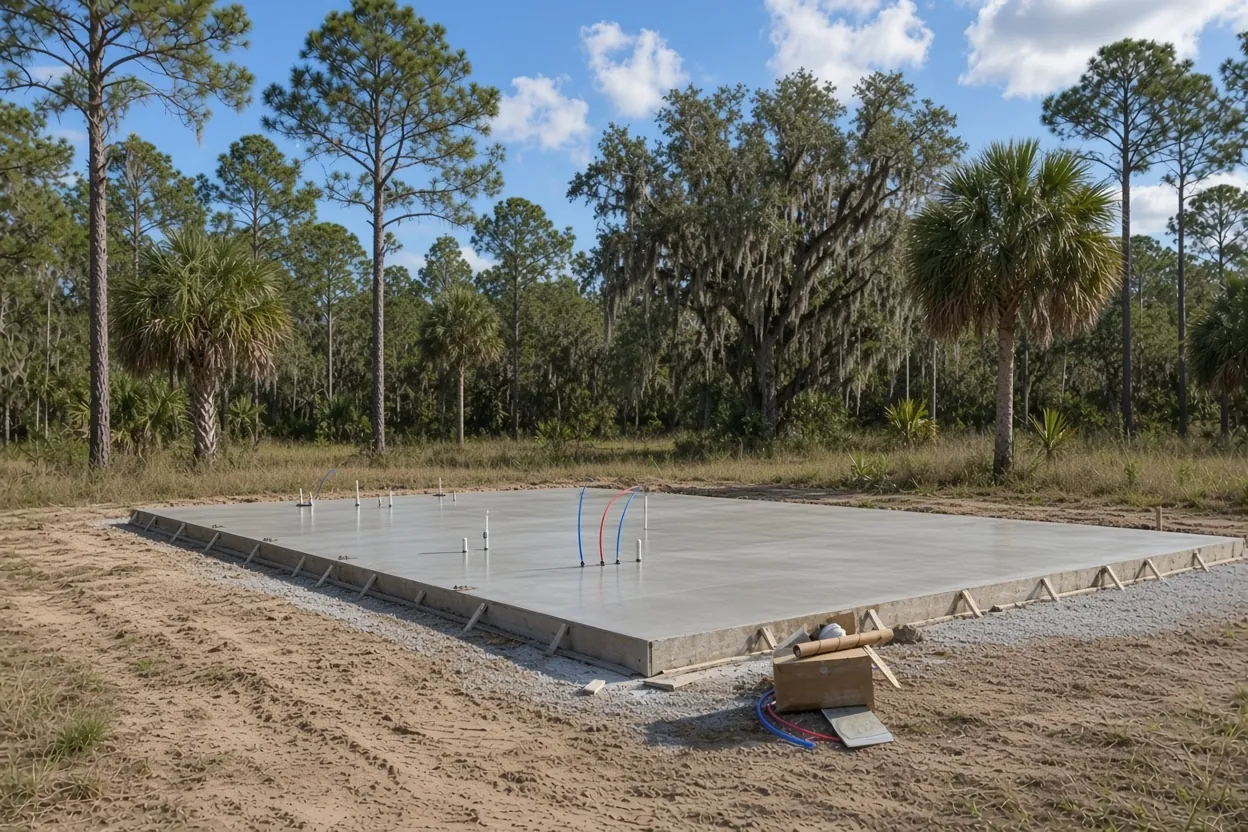
Pour to the plans
We set forms and steel to the drawing or your agreed spec, pour, and cure the slab.
Polk County's affidavit: what you sign and what it says back
Polk County asks farm-building owners to sign an Agricultural Exemption Affidavit (form PD BLD 05, revised 6/23/2023). Read what it actually says.
- It states that you are exempt from the Florida Building Code and the Polk County Land Development Regulations under s. 604.50.
- It is valid only with an issued permit, so the exemption is still run through a permit.
- It is notarized.
- It warns that using the structure as a residence, or not primarily for agriculture, is a Land Development Code and Building Code violation.
- A false statement on it is a second-degree misdemeanor under s. 837.06 of the statutes.
Polk's permitting guide lists a non-residential farm building under miscellaneous permits and asks for full-size scaled construction plans and site plans, the tax or parcel ID, a deed if you are the owner-builder, a Notice of Commencement if required, and contractor information.
An exempt barn in Polk still means paperwork and a permit number. You skip the Florida Building Code review, not the front counter.
Setbacks and zoning: two readings, one phone call
Does the exemption also wipe out setbacks, easements and other land development rules? Two official sources point in different directions.
In 2001 the Florida Attorney General (AGO 2001-71) said s. 604.50 makes building permits unnecessary for nonresidential farm buildings, but that no statute exempts them from county land development regulations. That opinion predates the 2021 amendment that added the floodplain carve-out. Polk County's current affidavit, by contrast, states that the owner is exempt from the Polk County Land Development Regulations too.
You should not stake a slab on one reading of a disagreement. Confirm your setbacks with the Polk County Building Division in writing before forms go down. Polk's general permit page already says every slab must meet minimum setbacks from property lines and easements, and that building code and Land Development Code drainage requirements must be met. Pushing a barn a few feet toward a fence line, then learning it is too close, is an expensive mistake in concrete.
If your parcel is inside a city, the city decides. Ask that city, not the county.
Inside city limits, the city's building office answers
Polk County's Property Appraiser keeps a permit-agency list. It names Lakeland, Winter Haven, Haines City, Davenport, Lake Wales and Auburndale among the county's permit agencies, and an address outside a listed city goes to the Polk County Building Division in Bartow. A parcel with a Winter Haven mailing address might be inside the city or might not. Check the boundary before you call.
Cities do not all treat farm buildings the same way. Auburndale's Community Development FAQ says bona fide non-residential agricultural structures need not comply with the building codes, but a farm building permit is still required for land use and fire code enforcement. Its slab rule is separate: a permit for a slab on grade over 100 sq ft within 10 feet of the home or principal structure, or intended as the slab for construction. Lakeland, for its part, says every accessory building needs a permit, with one exception for a small storage shed not attached to the main building that stands 5 feet tall or less and holds 250 cubic feet or less.
For Haines City, Winter Haven, Davenport and Lake Wales, call the office. The fee schedules and checklists are posted online, but a farm-exemption rule may not be. A five-minute call beats a wrong assumption.
What the exemption leaves standing: floodplain rules and dwellings
Two pieces of s. 604.50 still bind you. First, the exemption does not reach code provisions that implement floodplain management rules. A farm barn in a mapped flood zone still has to follow those rules, which means elevation and construction details can still apply to the barn and its slab. Second, a residence never qualifies.
If you are planning to live in the building, treat it as a house from day one. See our barndominium foundation page for what that changes under the slab: sealed plans, termite treatment and a different inspection path.
Mixed-use plans need care. A barn with a finished apartment above it, or a shop with living space, is a building meant partly as a dwelling, and the statute's definition leaves dwellings out. Polk's affidavit calls residential use a code violation. If you are unsure where your plans fall, ask before you buy materials, not after you have poured.
No code review means you write the slab spec
An exempt barn skips the building code, and that includes the slab rules a house would follow. No code minimum sets the thickness, the steel or the base under a barn floor that rides on the exemption. That's freedom, and it's also responsibility. The spec has to come from you, your kit supplier or your engineer.
Start with what will sit on the floor. Hay and a mower are a light load. A loaded tractor, a cattle trailer or a parked sprayer is not. Our pole barn slab cost guide shows what each extra inch and each lane of steel adds, and the ground under the pad matters just as much as the concrete on top of it.
The permit side has one more wrinkle. Polk lists slabs adjacent to a principal or accessory structure, and meant to support a structure, as work that needs a construction permit. If your barn rides on the affidavit, ask the Building Division whether its slab does too, and get the answer in writing.
Our prices for farm floors are $6 to $11 per sq ft for agricultural and equipment slabs, $7 to $12 for a pole barn floor and $7 to $13 for a horse barn, each set in a free written estimate after we see the site. If there's an engineer's drawing, we follow it to the letter. If not, bring the loads.
Paper to gather before you call the building office
A clean packet gets a faster answer. Here's the list for a farm building in Polk County.
- Your tax or parcel ID, and a copy of the deed if you are the owner-builder.
- Proof the land qualifies: the agricultural classification, or whatever the office accepts as an operating farm.
- A site plan showing where the building sits against property lines and easements.
- Full-size scaled plans of the building, including the foundation.
- The notarized Agricultural Exemption Affidavit, if the office says to bring it.
- A Notice of Commencement, if one is required for your job value.
- Contractor details, and your flood zone.
Once you know the permit path, send us the drawing. Call (863) 269-3083 or use the contact page. The on-site estimate is free, and the written quote follows within 48 hours.
Questions We Get
Do farm buildings need a permit in Florida?
Does my land have to be classified agricultural to use the exemption?
Can I build a barndominium under the farm-building exemption?
What is Polk County's Agricultural Exemption Affidavit?
Do setbacks still apply to an exempt farm barn in Polk County?
Does Auburndale require a permit for a farm building?
Who do I call if my farm is inside Winter Haven or Lake Wales?
Do floodplain rules apply to an exempt farm building?
Does the exemption cover my concrete slab?
Sources we used
- Florida Statutes s. 604.50 Nonresidential farm buildings; farm fences; farm signs, Florida Legislature (Online Sunshine)
- Florida Statutes s. 193.461 Agricultural lands; classification and assessment, Florida Legislature (Online Sunshine)
- AGO 2001-71 Nonresidential farm building, zoning/building permits, Florida Attorney General
- Agricultural Exemption Affidavit (PD BLD 05, 6/23/2023), Polk County Office of Planning and Development - Building Division
- Permitting and Plans Review Guide, Polk County Building Division
- Building Permitting - Polk County, Polk County Building Division
- Community Development Frequently Asked Questions, City of Auburndale
- Permit Requirements - Building Inspection, City of Lakeland
- Polk County Property Appraiser permit agencies list, Polk County Property Appraiser
- Florida Statutes s. 553.73 Florida Building Code, Florida Legislature (Online Sunshine)
- Florida Statutes s. 823.14 Florida Right to Farm Act, Florida Legislature (Online Sunshine)
- 2022 Census of Agriculture County Profile: Polk County, Florida, USDA NASS