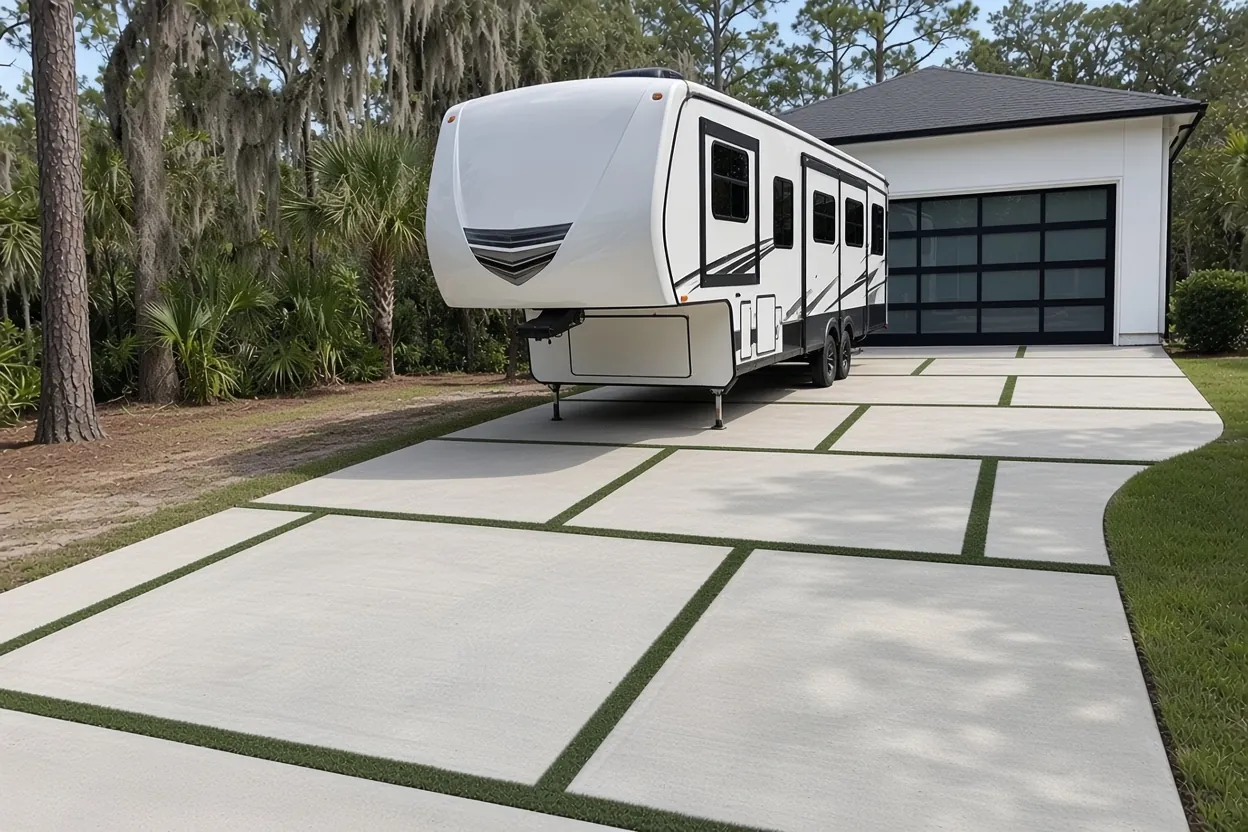
Motorhome, fifth-wheel or bass boat: what the pad has to carry
A concrete RV pad is a long slab that holds a motorhome, fifth-wheel or travel trailer without the yard rutting under it. A boat storage pad does the same job for a trailer and hull. A carport slab is either one with a roof planned for later. The pour is the same. The load and the layout are not.
Grass and loose shell give way under tires, tongue jacks and stabilizer pads, and a rig parked on sand settles a little more every rainy season. Concrete gives you a level stance, a dry spot to hook up and a surface you can wash down.
Concrete Barn Slabs Polk County pours RV and boat pads across Polk County and leans toward jobs in Lakeland, Winter Haven, Haines City, Davenport and Lake Wales. If the slab is going under a building rather than a rig, the storage building slab page fits your job better.
Length, slide-outs and a flared apron for the trailer's swing
Size the RV pad to the longest rig you might own in ten years, not the one sitting in the driveway now. Then add width for slide-outs, the awning and a dry walkway on the door side. That strip is cheap to pour now and hard to add later.
Pads come in two layouts.
- Pull-in strip. A narrow slab beside the house or barn, say 12 by 50 feet, where you pull in nose first and back out.
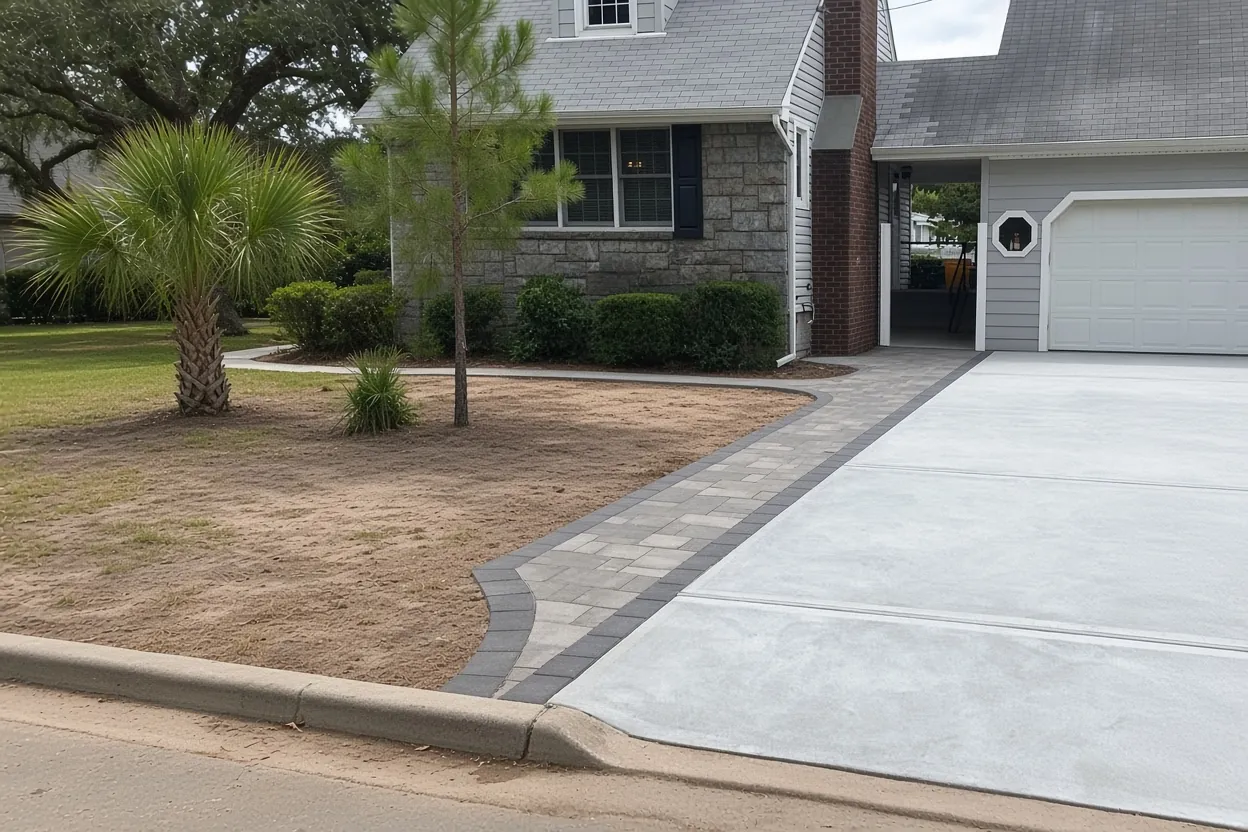
- Back-in pad with an apron. A wider slab off the main driveway with a flared entry, so the trailer wheels don't drop off the edge on a tight turn.
The apron is where a pad takes the most abuse. A trailer tracks inside the tow vehicle on a turn, so the corner of the entry takes tire scrub every time you park. We flare it wide enough for your swing and thicken it where the wheels bite. Before we set forms, we'll ask you to back the rig in once while we mark the tire path on the ground. Ten minutes with a can of paint saves a corner that cracks off later.
Leave a clear lane to the sewer cleanout or dump spot, and mark where the power pedestal goes so the electrician's conduit can run under the slab instead of across it.
What It Costs
Our RV and boat pad rate is $8 to $14 per sq ft, and our typical project range is $4,000 to $12,000 depending on size, fill and the apron. The rows below are the square footage times that rate.
| Pad size | Per sq ft | Slab range | What moves the price |
|---|---|---|---|
| 12x50 pull-in strip (600 sq ft) | $8 to $14 | $4,800 to $8,400 | Fill depth, truck reach |
| 16x40 back-in pad (640 sq ft) | $8 to $14 | $5,120 to $8,960 | Flared apron, thickness, steel |
| 24x30 carport slab (720 sq ft) | $8 to $14 | $5,760 to $10,080 | Thickened edges or post footings |
| 20x40 pad for a larger coach (800 sq ft) | $8 to $14 | $6,400 to $11,200 | Deeper section, rebar |
| 30x40 RV and boat pad (1,200 sq ft) | $8 to $14 | $9,600 to $16,800 | Two bays, pump or chute, drainage |
Section depth and steel under a loaded coach
The Florida Building Code Residential sets 3 1/2 inches as the minimum for a slab on ground. That number is written for house and garage floors, and a loaded Class A coach on a jack pad is a different load. We set the thickness of your RV pad from the heaviest axle that will ever sit on it and the ground under it, and the figure goes in your written quote.
The code's strength table lists carport and garage slabs at 2,500, 3,000 or 3,500 psi depending on how hard the weather can hit them. Your quote names the mix.
For crack control, the code accepts synthetic fiber at 0.75 to 3.0 pounds per cubic yard, or 6x6 W1.4xW1.4 welded wire carried in the middle to upper third of the slab. Rebar is the other path. We lean toward it under a heavy coach or a tandem-axle boat trailer, where the same wheels set down on the same spot for years.
Long, narrow pads are hard on joints. NRMCA's joint guidance keeps spacing at 2 to 3 feet per inch of thickness, never over 15 feet, with panels close to square. A 12-foot-wide strip gets saw cuts across it at a spacing that keeps each panel near square, and we keep the cuts out of the tire path where we can.
How the Job Goes
Walk the tire path
We meet you on site, look at the ground and the drainage, and mark where the rig actually tracks when it backs in.
Written quote
Pad size, thickness, steel, apron and finish, spelled out so you can compare it line by line.
Permit check
You confirm with the city or the county whether the pad or the future cover needs a permit, and we build to what they say.
Strip, fill and shape
Topsoil comes out, fill goes in compacted, and the grade is set so water leaves the pad.
Forms, steel and cover footings
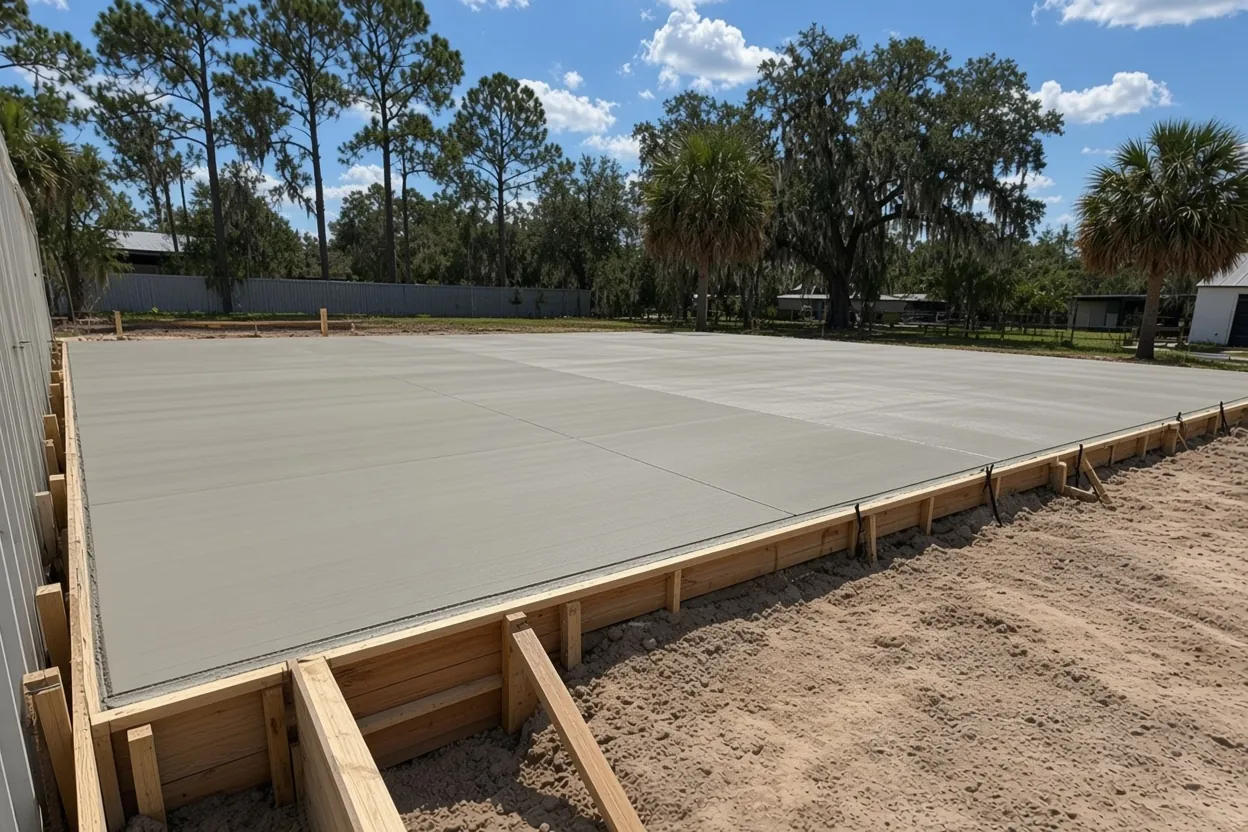
Edges, fiber or rebar, and any post footings for a future carport go in before the truck.
Pour, cut and cure
We pour in the cooler hours, saw the joints, start the cure and tell you when the rig can roll on.
Grade, fill and where the rainwater goes off the pad
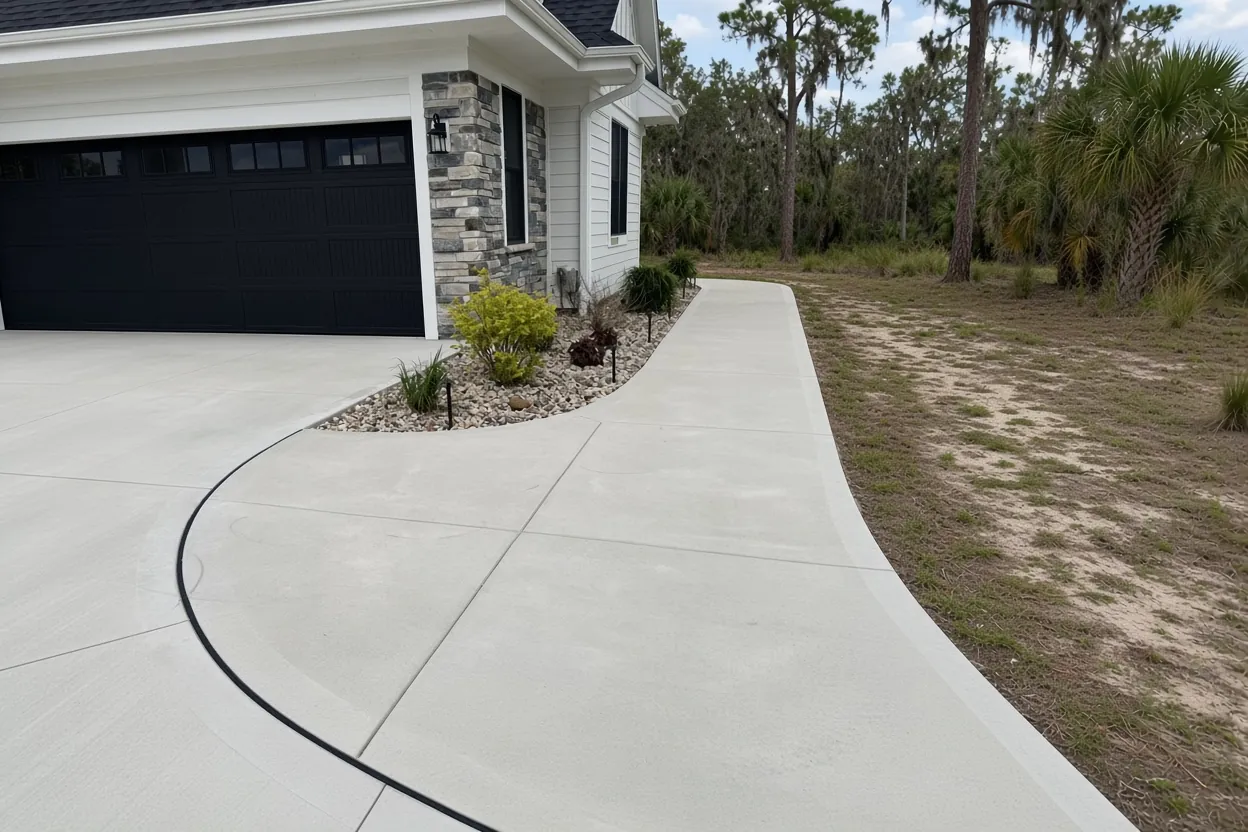
A pad that holds water stains, gets slick and softens the sand at its edges. We shape every RV pad to shed water to the sides and away from the house, then blend the apron into your existing driveway so a hitch or a low step doesn't catch a lip.
The Polk County Building Division says all slabs must meet setbacks from property lines and easements, and must meet Building Code and Land Development Code drainage requirements. A pad that dumps its runoff onto the neighbor's lot or into a septic field is the kind of thing an inspector flags.
Under the concrete, the code wants vegetation and topsoil out and fill compacted for uniform support, with clean sand or gravel fill capped at 24 inches unless the building official approves more. A low lot that needs more than that is a question for the building official or an engineer before the pour. Polk ground runs from poorly drained flatwoods sand to fast-draining ridge sand; our pole barn slab page shows how to tell which one you're on. A summer pour starts early to beat the afternoon storms.
Before the pour, mark the septic tank, drain field, well line and any buried power you know about. A heavy pad sitting on a drain field is a problem no finish can fix.
Which counter permits the pad: Lake Wales, Lakeland, Davenport or the county
Start with one question: is the address inside a city's limits or in unincorporated Polk County? Each answer sends you to a different office.
- Unincorporated Polk: the county lists slabs adjacent to a principal or accessory structure, or intended to support one, as permit work, and its FAQ adds carports with rigid roofs. A pad out in the yard can read differently from one tight against the house, so ask with your site sketch in hand.
- Lake Wales: the city's permit list names driveways and parking pads outright, so a pad inside city limits starts on the list.
- Lakeland: all accessory buildings, detached carports included, need a building permit.
- Auburndale: slabs on grade over 100 sq ft within 10 feet of the home, or meant to carry a structure, need a permit.
- Davenport: the checklist asks for a survey or plot plan with setbacks, and an elevation certificate before slab inspection on property in a flood hazard area.
Winter Haven and Haines City each run their own building divisions, so a pad inside either city goes to that city's counter. On a farm parcel, the farm building permit guide explains what the ag exemption covers and what it doesn't.
Planning the slab now for a carport or RV cover later
Pouring the pad this year and buying the cover next year works, if the slab is built for it. A carport or RV cover is a building, so it brings wind loads and anchors that need concrete with enough depth to grab.
Design wind speed comes from the Florida Building Code wind map, applied by the cover's engineer, so we don't quote a number for your lot. What we can do is get the post footing and anchor details from the carport or metal building company before we pour. If the posts land on the pad edge, a thickened edge or a footing under each post goes into the same pour. Adding anchors afterward means drilling cured concrete and hoping the edge holds.
If you haven't picked the cover yet, tell us the likely width and post spacing and we'll keep the edges and the layout open for it. In Lakeland the cover is an accessory building with its own permit; in unincorporated Polk a carport with a rigid roof needs one too. We take the supplier's drawings the same way we do on a metal building foundation, and pour to them as drawn.
Rig numbers, a sketch and a gate photo for your quote
The site visit is free, and you get a written quote after it. Send these ahead and the visit goes faster.
- Overall length of your longest rig, slide-out width, and its weight if you have it.
- Whether a boat, a second trailer or a work truck will share the slab.
- A phone photo or sketch of where the pad goes and which way the rig comes in.
- The carport or cover you plan to add, with the supplier's footing drawing if you have one.
- Septic tank, drain field, well, water and power lines near the spot.
- Gates, trees, fences or low wires on the route a concrete truck would use.
- Your address, and whether it's inside city limits.
Call (863) 269-3083 or use the free estimate form.
Questions We Get
How thick should an RV pad be?
Can an RV pad have a carport added later?
Is a parking pad on the Lake Wales permit list?
What does a 12x50 RV pad cost?
Can one slab hold the motorhome and the boat trailer?
Where should the rain go off an RV pad beside the house?
Can a concrete truck reach a pad behind the house?
When can the motorhome roll onto the new pad?
Sources we used
- 2023 FBC Residential R506 Floors (slab thickness, fill, vapor retarder, joints), ICC / Florida Building Commission (via UpCodes)
- 2023 FBC Residential R402.2 and Table R402.2 (concrete strength), ICC / Florida Building Commission (via UpCodes)
- Building Permitting - Polk County, Polk County Building Division
- Building Permitting FAQs, Polk County Building Division
- Permit Requirements - Building Inspection, City of Lakeland
- Permit Requirements, City of Lake Wales
- Community Development Frequently Asked Questions, City of Auburndale
- Building Permit Submission Checklist, City of Davenport
- CIP 6 - Joints in Concrete Slabs on Grade, National Ready Mixed Concrete Association (NRMCA)