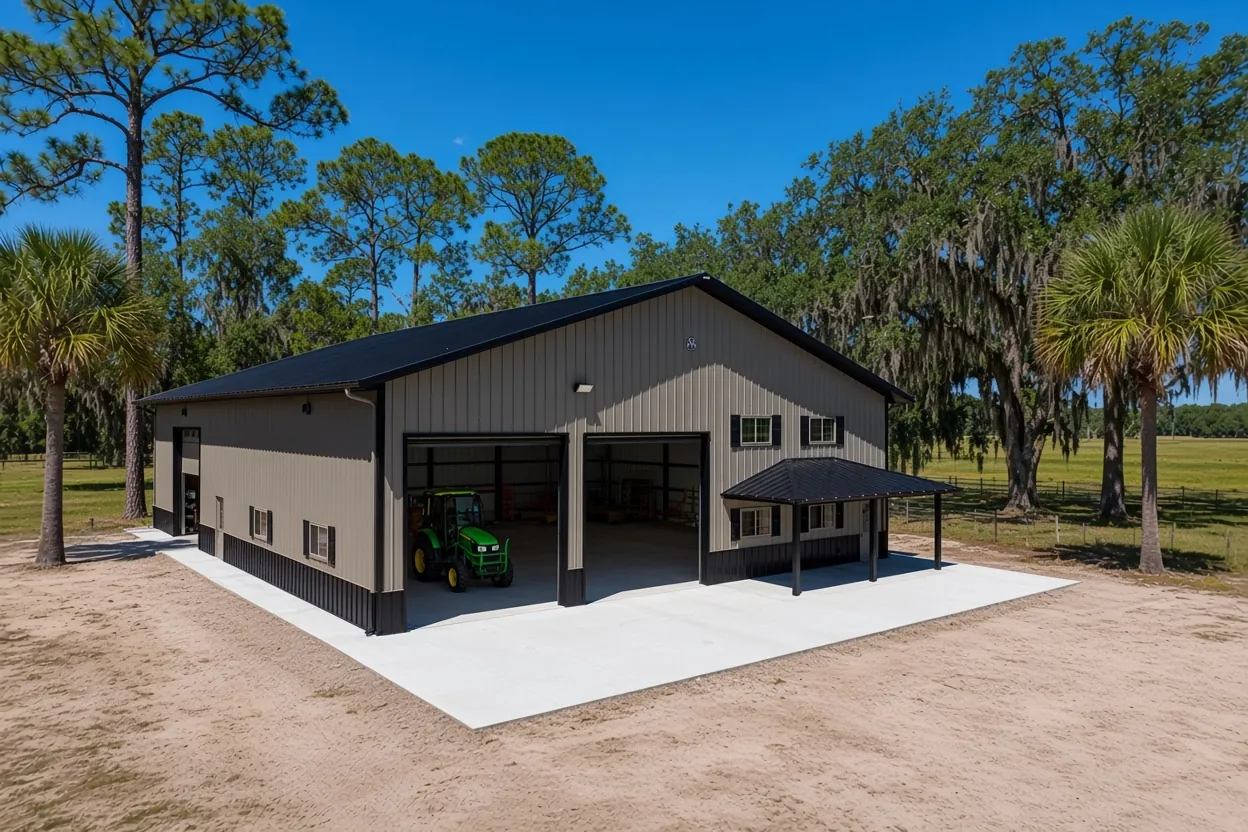
Shed floors, hay lanes, feed pads and wash pads on working ground
A farm slab is a work surface before it's anything else. It might sit under a tractor shed, a hay barn or a packing building, or out in the open as a feed pad or a machinery wash pad. It takes steel wheels, loader buckets, wet boots and a scraper blade, and it gets hosed off more than any floor in a house.
Concrete Barn Slabs Polk County pours agricultural and equipment slabs across Polk County, centered on the stretch from Lakeland east through Haines City and Davenport and south to Lake Wales. The jobs run from a single tractor bay to a wide machinery building with several pour days.
The sections below go job by job: equipment floors, hay storage, livestock pads, grove and nursery slabs, and getting a truck to all of them. If the building is a post-frame barn, the pole barn slab page covers the frame-and-floor order.
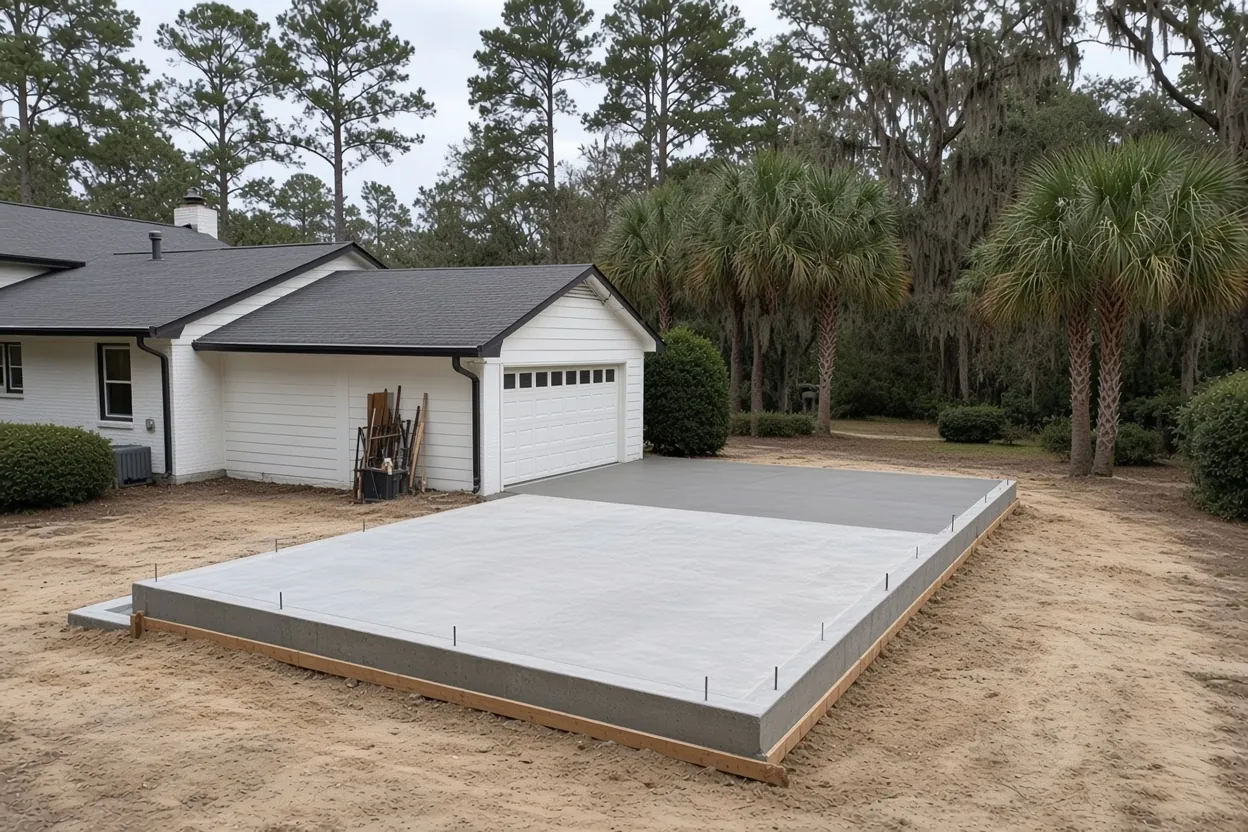
Sizing an equipment floor to the loader, not the building
Start with the heaviest thing that will roll across the floor, not the building's square footage. A compact tractor and a loaded hay wagon ask different things of a slab, and a full loader bucket or a filled spreader concentrates even more weight on two tires.
The Florida Building Code's 3 1/2 inch figure is the minimum for slab-on-ground floors in houses and garages. It's a starting line, not the answer for a machinery shed. We set a farm floor's thickness, and its fiber, welded wire or rebar, from the heaviest load you name, and the number goes in your quote. Heavy or concentrated loads go to an engineer, and we pour to the plans.
Four details make or break an equipment floor:
- Door edge. The slab edge under a roll-up or open bay takes every turn of a loaded tire, so we thicken it.
- Apron. A short transition slab keeps the sand approach from rutting where wheels turn onto the floor.
- Joints. Following NRMCA, panels stay close to square, joints sit no more than 15 feet apart, and we keep them out of the path where a bucket edge drags.
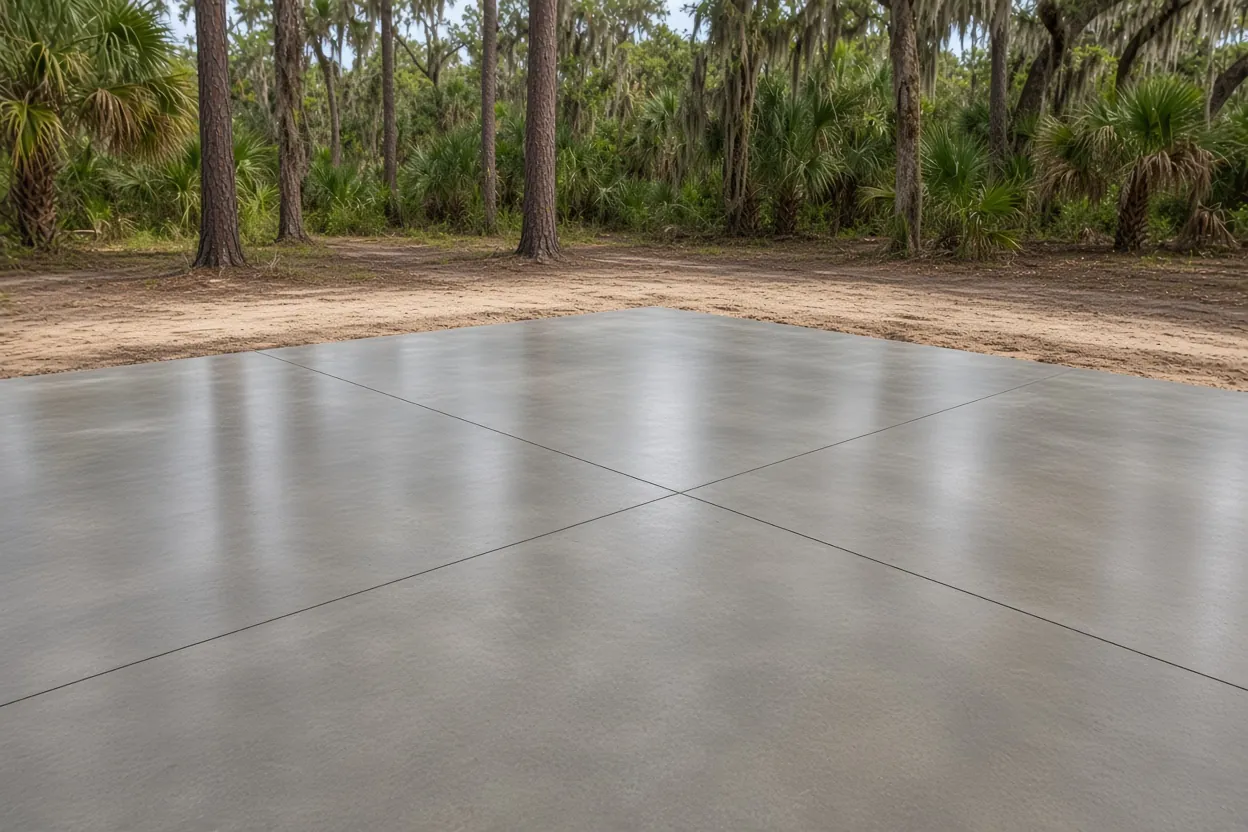
- Surface. A broom texture for footing, with enough pitch that a hose clears the floor.
Tell us what you run now and what you plan to buy. Pouring for next year's tractor costs less than cutting out a cracked bay.
What It Costs
Our farm slab rate is $6 to $11 per sq ft, and projects run from $6,000 to $40,000 or more depending on size, load and site work. Each row is the floor area times that rate.
| Farm slab | Per sq ft | Slab range | What moves the price |
|---|---|---|---|
| 24x48 feed or wash pad (1,152 sq ft) | $6 to $11 | $6,912 to $12,672 | Pitch, curbs, drain outlet |
| 30x40 tractor shed (1,200 sq ft) | $6 to $11 | $7,200 to $13,200 | Thickness, thickened door edge |
| 40x60 hay barn (2,400 sq ft) | $6 to $11 | $14,400 to $26,400 | Raised pad, fill, bale lane or full floor |
| 50x80 equipment barn (4,000 sq ft) | $6 to $11 | $24,000 to $44,000 | Engineered load, rebar, pump access |
| 60x100 machinery building (6,000 sq ft) | $6 to $11 | $36,000 to $66,000 | Several pour days, engineered design |
Hay storage: lifting bales off damp sand
Polk farmers had 18,803 acres in hay and forage in the 2022 Census of Agriculture, and a wet bottom row is money you pay for twice. A hay barn floor has one job: keep moisture coming up from the sand away from the bales.
Concrete does that when it sits above the surrounding grade and the edges shed rain outward. On flatwoods ground, where the seasonal high water table can sit within a foot and a half of the surface for about four months a year, we raise the pad with compacted clean fill and pitch the edges out. A slab poured in a low spot sits in the wet instead of above it.
Ask about a vapor retarder. The code calls for a 6-mil poly sheet under slabs but exempts unheated accessory structures, and an open hay barn may fall under that. If the building might store grain, feed or sensitive equipment later, have us price the poly anyway; it can't be added under a finished floor.
You don't have to pour wall to wall. A concrete bale lane down the middle, with the bays on either side left as packed base, keeps the loader on hard ground and cuts the square footage. Mark which way the bales come in so the lane lines up with the door.
How the Job Goes
Farm walk
We walk the footprint and the truck route, look at drainage and go over the machines that will use the floor.
Written quote
Areas, thickness by zone, steel, finish and access work, with a pump or stone track priced when the route is in doubt.
Exemption or permit
You settle the exemption affidavit, farm building permit or standard permit with the office, and we build to it.
Pad and drainage
Topsoil comes out, clean fill is compacted, and the pad is set above the surrounding grade.
Edges, forms and steel
Thickened door edges, curbs, fiber or rebar go in per the plans or the engineer's drawing.
Pour, texture and cure
We pour early, texture for footing, saw the joints and keep machines off until the slab is ready.
Feed and loafing pads that a scraper blade can clean
Polk had 109,225 head of cattle and calves at the end of 2022. Around a feed bunk, a water trough or a working pen, that traffic turns bare ground to mud in one wet week. A concrete feed or loafing pad holds up, and it gets scraped and washed down constantly, so it has to be built for the blade.
A livestock pad needs four things from us:
- A pitch to one edge or a collection point so wash water leaves the pad.
- A rough, scored surface so animals and boots hold footing when it's wet.
- A raised curb on the low side if you want runoff sent one way instead of spread.
- A firm, even base, because a scraper finds every dip and every high joint.
Where the runoff goes is a design and permit question. The Polk County Building Division requires slabs to meet Building Code and Land Development Code drainage rules, so a pad needs an outlet plan that fits the parcel. We set the pitch and bring in an engineer if the site or the herd size calls for one.
Walk us past the fence lines, troughs and gates on the visit. Moving a trough after the pour means saw-cutting.
Grove and nursery slabs near Lake Alfred and Lake Wales
Fruit is the biggest line in Polk's farm sales: $158.0 million in 2022, with 63,900 acres of oranges, plus $55.7 million in nursery, greenhouse and sod. Behind those numbers sit equipment shed floors, sprayer pads, loading slabs and potting floors.
Grove ground has its own rules. UF/IFAS notes that flatwoods citrus sites are leveled, bedded and ditched to drain, and that most flatwoods soils have a restrictive layer that can perch the water table. A slab near a bedded block has to work with that drainage, not dam it. We set pads above the bed and swale grades and keep the apron's runoff out of the rows.
The City of Lake Wales soil map shows Candler ridge sand and Immokalee and Myakka flatwoods sand in and around one city, so one grove can need two answers: on the ridge the worry is a truck sinking in deep, loose sand, and in the flatwoods it's pad height and ditch lines. Up in Lake Alfred, home of the UF/IFAS Citrus Research and Education Center, the same check applies block by block.
Sprayer wash pads are their own conversation. What drains off them, and where it goes, is a compliance matter for you, your engineer and the agency that regulates it. We build the slab, pitch and curb to the plan they sign off on.
Exempt farm building or permitted one: what changes for the slab
Florida Statute 604.50 exempts a nonresidential farm building used primarily for agriculture from the building code, with floodplain rules still in force; the farm building permit guide covers who qualifies and what Polk's affidavit says. Here's what it means for the concrete.
- The slab spec doesn't relax. An exempt shed still carries the same tractor. We pour it to the load and the ground, exempt or not.
- Paper still comes first. Polk's Agricultural Exemption Affidavit is valid only with an issued permit, so settle the path with the county before the pour date.
- Cities run their own counters. Auburndale still requires a farm building permit for land use and fire code, and Lake Alfred lists a Permit Exemption Request form among its permit downloads.
- Living space breaks the exemption. A shop with an apartment or a barndo isn't a farm building; our barndominium foundation page covers that build.
Getting a loaded ready-mix truck across pasture sand
On a farm, the truck route can set the pour date. A loaded concrete truck can bog down in soft pasture sand, sink a culvert pipe or rut a grove row it was never meant to cross. We walk the route in with you: gate width, cattle guards, ditch crossings, overhead wires and the spot where a pump truck could set up if the chute can't reach.
Sometimes a temporary stone track to the pad costs less than a pump. Sometimes the pump is cheaper than repairing a pasture. We'll price both when the route is in question, so you pick with numbers in front of you.
Tell us when the building has to be in service and what's happening on the farm that month. A pour can work around a hay cutting or a harvest crew if we know about it, and a summer job gets an early start to beat the afternoon storms. We won't let a machine roll onto a green slab, so plan a few days where the shed stays empty.
The ground under the pad matters too. Polk soil runs from fast-draining ridge sand to poorly drained flatwoods; the pole barn slab page shows how to tell which one a site sits on.
Equipment list, gate photo and parcel number for your quote
The visit is free, and the written quote follows it. Have these ready, or send them ahead.
- The heaviest tractor, loader, implement or trailer, and whether its load sits on a few wheels.
- Building plans or the supplier's drawing, with door openings and clear height.
- A sketch of the pad, feed pad, wash pad or hay lane, and where water should leave.
- A photo of the gate and the route a concrete truck would take.
- Fences, troughs, wells, utilities or grove beds near the footprint.
- The parcel number, and the agricultural classification or farm operation details if you plan to use the exemption.
Call (863) 269-3083 or use the free estimate form.
Questions We Get
Are farm buildings exempt from Florida building permits?
What slab do I need for heavy tractors and implements?
What does a 40x60 hay barn floor cost?
Can you pour a feed pad for cattle?
Will a slab block the drainage on my bedded grove?
Will a loaded concrete truck make it across my pasture?
Can the slab go in under a shed that's already standing?
When can I roll the tractor onto a new slab?
Sources we used
- Florida Statutes s. 604.50 Nonresidential farm buildings; farm fences; farm signs, Florida Legislature (Online Sunshine)
- Agricultural Exemption Affidavit (PD BLD 05), Polk County Building Division
- 2022 Census of Agriculture County Profile: Polk County, Florida, USDA NASS
- Community Development Frequently Asked Questions, City of Auburndale
- Building Permits, City of Lake Alfred
- SL456/SS669 Chapter 2: Nutrition of Florida Citrus Trees, UF/IFAS Extension (EDIS)
- Soils and Minerals (Comprehensive Plan map), City of Lake Wales
- Citrus Research and Education Center, UF/IFAS
- Building Permitting - Polk County, Polk County Building Division
- 2023 FBC Residential R506 Floors, ICC / Florida Building Commission (via UpCodes)
- CIP 11 - Curing In-Place Concrete, National Ready Mixed Concrete Association (NRMCA)
- CIP 6 - Joints in Concrete Slabs on Grade, National Ready Mixed Concrete Association (NRMCA)