Every Auburndale shed needs a permit, and so does its slab
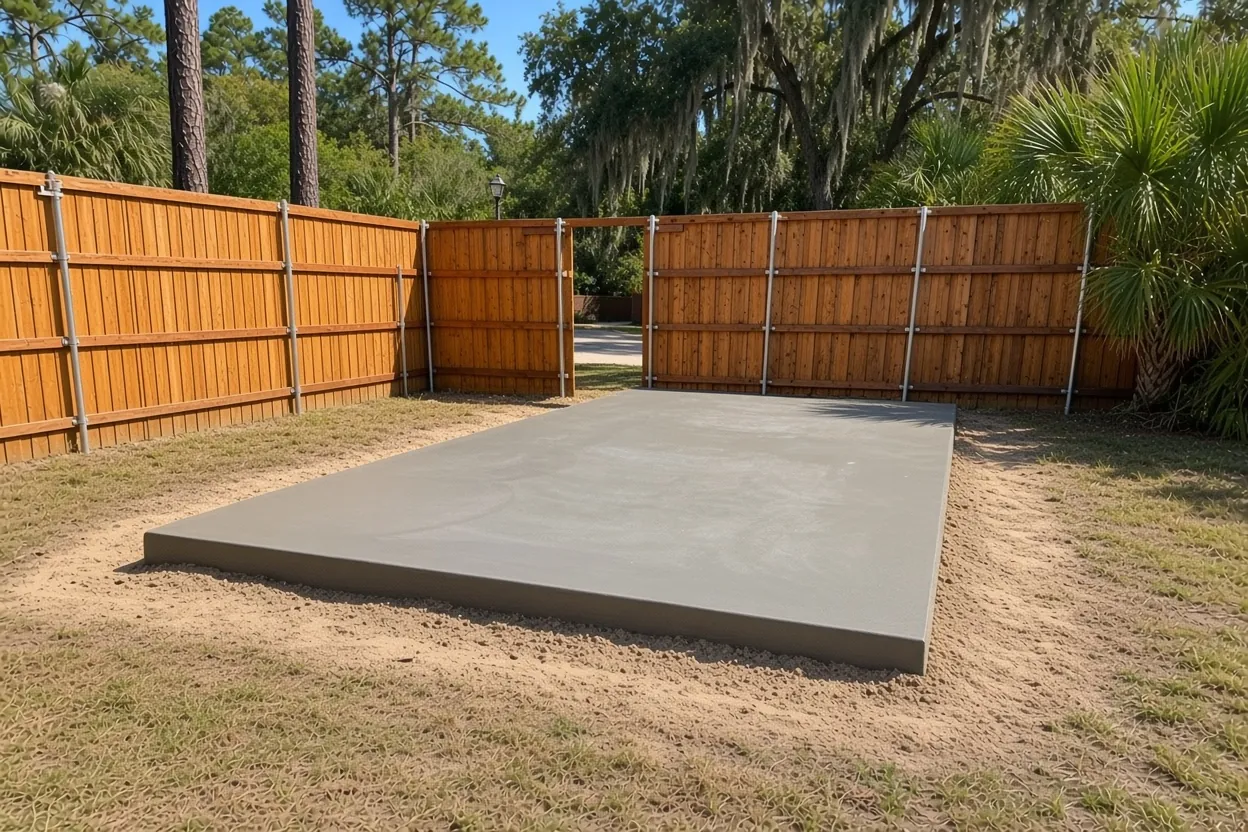
Auburndale answers the shed question directly. Its Community Development FAQ asks whether you need a permit to put up a small shed, and the answer is yes: a permit is required for any shed, so the city can check that it's installed safely and meets building and zoning codes. The same FAQ's list of permit work names sheds over 48 square feet, over 6 feet high, or with electric or plumbing, so don't read the 48 square foot line as a free pass for a 6x8. The concrete has its own line too: a slab on grade needs a permit when it's over 100 square feet within 10 feet of the house, or when it's intended as a slab for construction. A pad poured to hold a shed is a slab for construction, wherever it sits on the lot.
The FAQ also warns that property insurers may not cover work done without a permit and inspections. Portable carports with rigid roofs are on the permit list too, so bolting a metal carport to a new pad won't get you around it. Our shed slab service page explains the job across Polk County, and the Auburndale concrete slab contractor page covers barns, shops and garages in the city.
Filing with Construction Services on East Park Street
The City of Auburndale's Construction Services office, at 108 East Park Street, registers contractors, issues building permits, reviews plans and inspects buildings under construction in the city. Applications go through the city's online Building, Permitting and Licensing Platform, linked from the Construction Services page, with separate user guides for residents and contractors.
Build your calendar around three dates. Once the application and drawings are in, the city's FAQ says a permit may take up to one week to approve and issue, reviewed in the order received. After it's issued, the permit expires 6 months after issue or after the last approved inspection. You can ask in writing for an extension of up to 180 days before it lapses, but a permit expired more than 180 days can't be renewed.
Hold off on a delivery date from the shed dealer until the permit is in hand and the pad has cured. A homeowner living in the house may act as their own contractor when the home is for their own use and not for sale or lease. Decide early whether you or a contractor will hold the permit; either way, we follow the permitted drawing to the letter.
What It Costs
Shed and storage building slabs run $7 to $12 per square foot with us, and typical projects land between $1,800 and $5,000. Here are Auburndale shed sizes worked out at that rate.
| Job | Per sq ft | Slab area math | What moves the price |
|---|---|---|---|
| 10x16 shed pad (160 sq ft) | $7 to $12 | $1,120 to $1,920 | Anchor count, base prep, truck reach |
| 12x24 storage building pad (288 sq ft) | $7 to $12 | $2,016 to $3,456 | Thickness, fiber or wire, door ramp |
| 16x20 small shop pad (320 sq ft) | $7 to $12 | $2,240 to $3,840 | Raised pad on wet sand, joints, finish |
| Typical shed or storage building project | $7 to $12 | $1,800 to $5,000 | Size, thickness, anchors, site prep |
Five feet from the property line and from every other building
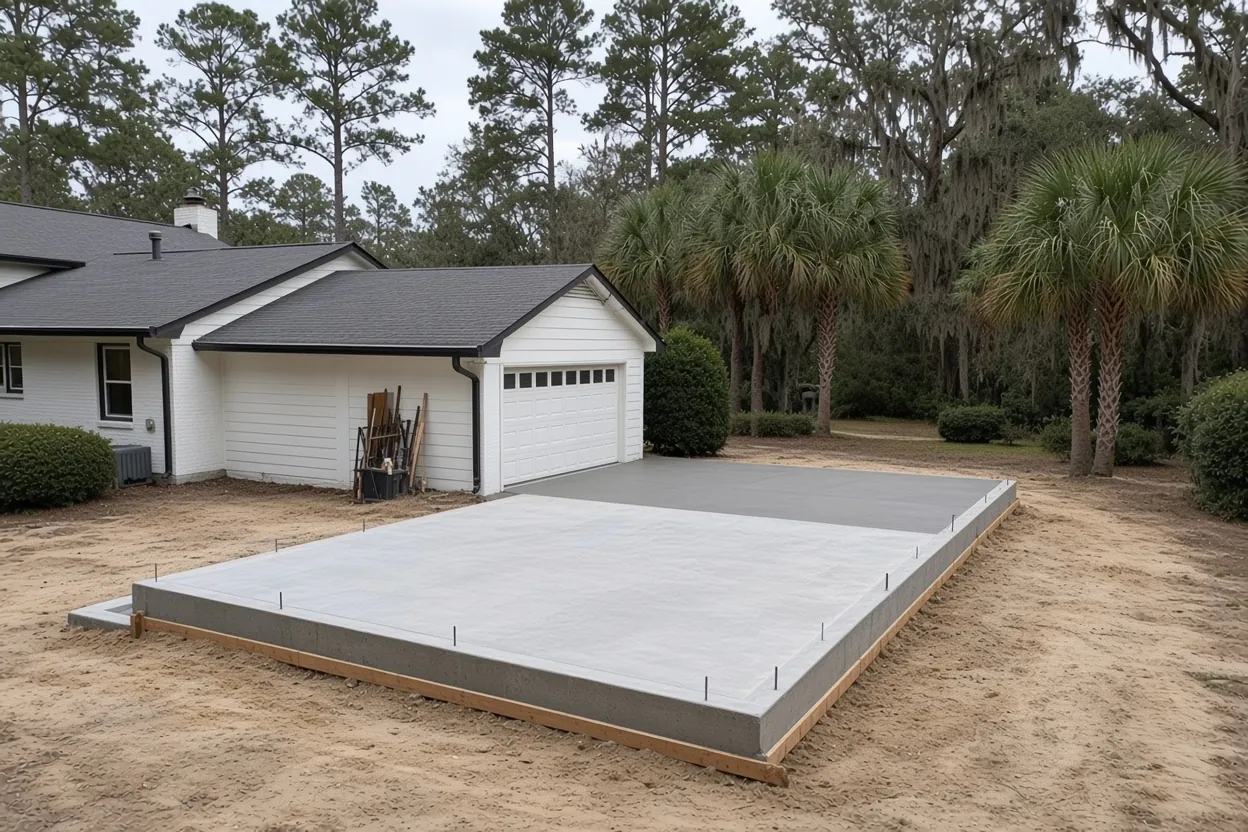
Auburndale's Land Development Regulations decide the layout. Section 5.2.2.1 keeps accessory structures out of required front yards and lets them sit in side or rear yards, but not side street yards, and not closer than 5 feet to the property line. The same section adds a rule that's easy to overlook: no separate accessory building may sit within 5 feet of any other building. Tuck a shed against the back wall of a garage or the side of the house and it breaks that rule.
RS-2 zoning lists private garages, tool houses and garden sheds among permitted accessory uses on a home lot. Section 5.2.2.2 lets patios and similar surface uses no more than 30 inches above median grade sit in side and rear yards, again no closer than 5 feet to the property line.
We set the forms with both 5-foot measurements in mind, from the survey line and from the nearest wall, and we keep any apron or ramp inside them too. Mark the corners on your survey before the site visit, and we'll check them with a tape.
How the Job Goes
Site walk
We measure the 5-foot lines from the property line and nearby buildings, and check lake distance on waterfront lots.
Written quote
Within 48 hours you get size, thickness, anchors and price in writing.
Forms and anchors
Forms set square to the maker's footprint, anchors placed to the drawing.
Pour, cure, deliver
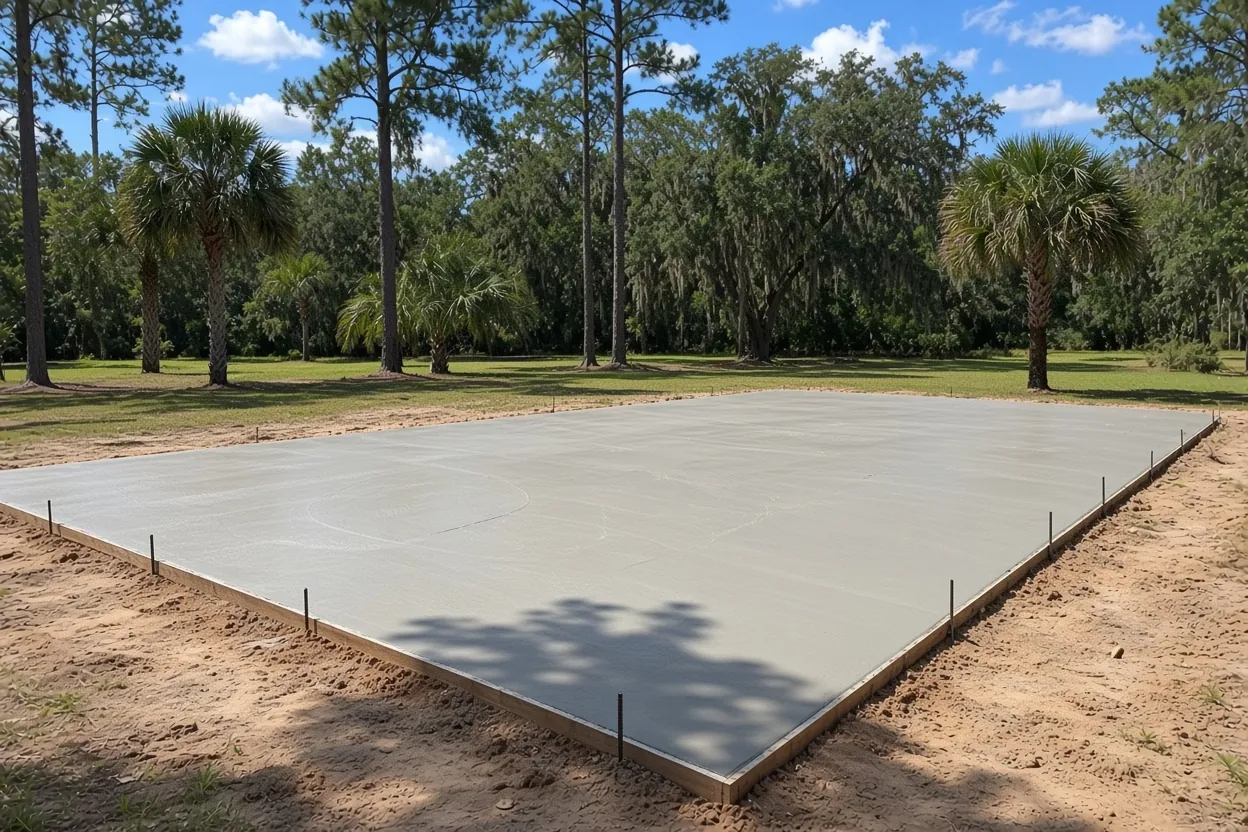
We pour and finish, keep the pad moist through the cure, then you call the shed company.
Lake lots: the 50 foot shoreline setback and the flood map
Auburndale is a city of lakes. Census hydrography puts Lake Ariana, Lake Arietta, Lake Juliana, Lake Mariana, Lake Agnes, Lake Myrtle, Lake Stella, Lake Medora, Lake Helene and Lake Lena among 17 named lakes inside or touching the city boundary, and a third of 30 sample points inside the 2020 city line fell on open water. The city's Lake Ariana Park rents out Hamann Hall for events.
That's why Section 5.2.8.1 matters for sheds. No building or structure other than a boat house or dock may be built within 50 feet of the shoreline of any lake or water body 10 feet or wider at normal water level. On a lakefront yard, measure 50 feet from the normal water line before you pick the shed spot.
Next, check the flood zone. At the same sample points, the FEMA flood map showed 50 percent Zone X, 40 percent Zone AE and 6.7 percent Zone A. Where approximate Zone A has no base flood elevation, the city's flood protection chapter lets the Floodplain Administrator set it at 3 feet above the highest adjacent grade (Section 14.1.5.2).
Candler sand, lakeshore muck and the base under the pad
The ground under Auburndale changes as you move away from the water. In the same 30-point sample, the most common land soil was Candler sand, 0 to 5 percent slopes, at 23 percent of points, plus Candler-Urban land complex at 7 percent. Candler is excessively drained, and the NRCS rates it not limited for dwellings without basements. Wet soils turned up as well: Samsula, Kaliga and Hontoon muck, very poorly drained and rated very limited, and Myakka fine sand along with Smyrna and Pomona fine sands, poorly drained with a seasonal water table about 15 centimeters down.
On Candler sand, the base work is straightforward. The building code calls for removing all vegetation, topsoil and foreign material, then compacting the fill for uniform support. Fill under a residential slab is capped at 24 inches of clean sand or gravel, or 8 inches of earth, unless approved. On the wetter flatwoods sands, we raise and shape the pad so rain runs off. If your spot maps as muck, move the shed to sandier ground.
A soft yard and a loaded truck don't mix. The Polk County Water Atlas notes that compacted soil takes in water poorly, and standing water can follow rain. We plan the truck route at the site visit to keep heavy wheels off the lawn wherever access allows.
Anchors that hold an Auburndale shed through storm season
Hurricane season runs June 1 to November 30, and the National Hurricane Center says most activity falls between mid-August and mid-October. A shed is big walls on a light frame, and the slab is what gives it grip.
Florida law exempts storage sheds that aren't designed for people to live in, with 720 square feet or less of floor area, from the mandatory wind-borne debris impact standards, under s. 553.73(10)(h). Wind-load design and anchoring still apply. Which wind speed applies isn't a one-size number. Florida's code puts minor storage facilities in Risk Category I (Table 1604.5), and Section 1609.3 assigns each risk category its own ASCE 7 wind map, so the shed maker's engineer or the building department picks the figure. We take the number from their sheet instead of quoting one ourselves.
We set anchor bolts or embeds where the manufacturer's drawing or your engineer's plan puts them, and check every spacing against the drawing while the forms are still in place. Building sits on a bolt-down base frame? Send the frame sheet so the pattern matches.
Mower shed or workbench shop: setting thickness and joints
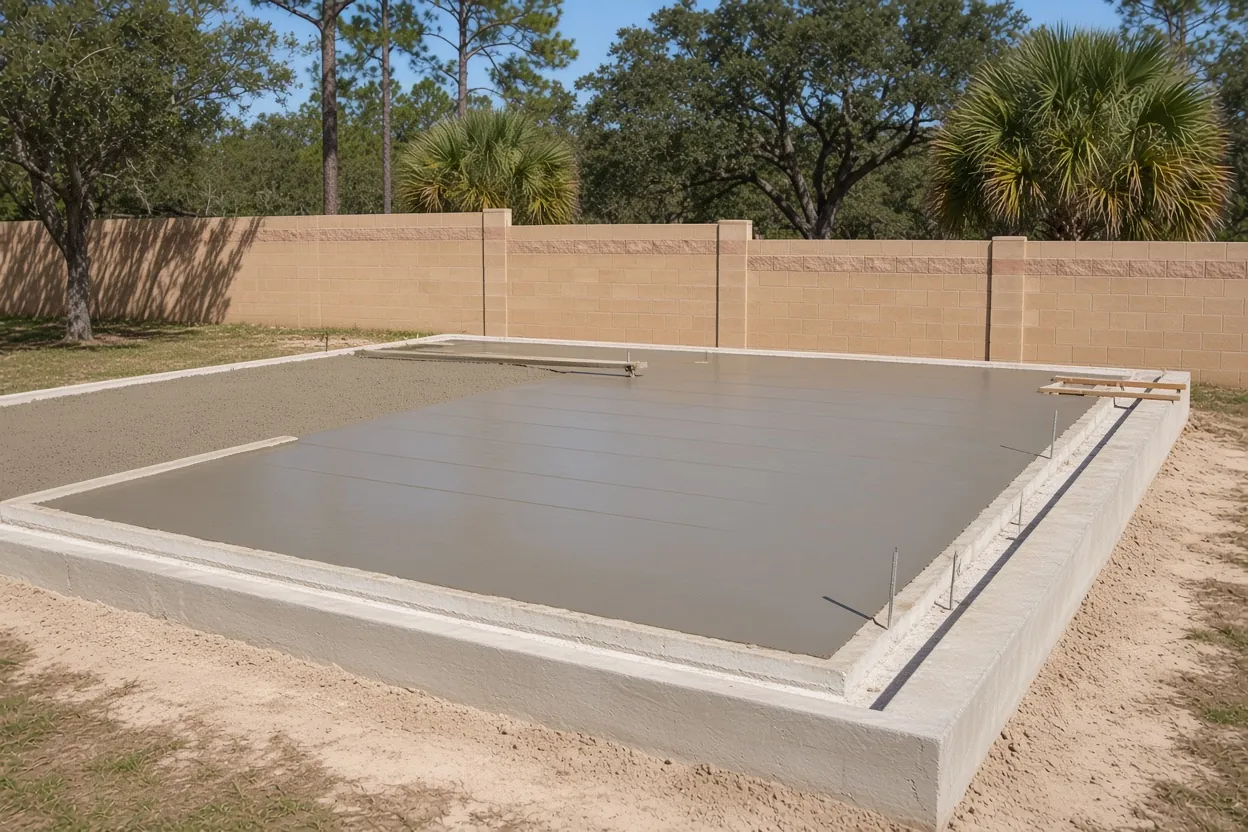
The Florida Building Code Residential sets a 3-1/2 inch minimum for slab-on-ground floors, and HUD's guide puts residential slabs at about 4 inches. That's enough for a garden shed with a push mower and hand tools. A storage building that will hold a garden tractor or a loaded bench gets the thickness your plan calls for.
For joints, NRMCA's rule is 24 to 36 times the slab thickness, never over 15 feet, with panels square or close to it. On a 4 inch slab that's 8 to 12 feet. A 12x24 pad takes a cut at the 12 foot mark for two 12x12 squares. A 16x20 gets one cut each way. Florida's code also lets synthetic fiber, or 6x6 W1.4xW1.4 welded wire in the middle to upper third of the slab, stand in for joints.
An unheated storage building falls under the accessory-structure exception, so the 6-mil vapor sheet is optional. Two cases change that: a shed you might air-condition later, and a permit that calls for termite soil treatment, since Florida's termite rule has treated soil covered in 6-mil poly before the pour. NRMCA calls for curing over 3 to 7 days, starting right after finishing, so we keep the pad wet or covered through that stretch.
Metal sheds south of I-4 and storage on OUA acreage
On the edges of town, two zoning layers can reach a shed. The Greater Auburndale JPA Overlay covers land south of Interstate 4 between SR 559 and the Polk Parkway (Toll 570), south to Old Dixie Highway, and applies to all new construction of buildings or structures in that area. Its design standards list bare metal and steel panels as prohibited surface materials unless finished with an approved material. If you're ordering a steel shed for a lot in that area, ask Community Development at 6 Bobby Green Plaza whether the rule reaches your building before you pay the deposit.
On Open Use Agricultural (OUA) land, impervious surface is capped at 20 percent on upland soils, and other soils stay unimproved. A concrete shed pad counts against that cover along with the house, barn and driveway. Check your zoning on the city's map viewer. For a working farm, Auburndale still issues a farm building permit for bona fide agricultural structures; our farm building exemption guide explains the state rule, and the Auburndale pole barn slab page covers larger storage barns.
Questions We Get
Does a 6x8 shed in Auburndale need a permit?
Can my shed sit right next to my garage in Auburndale?
How close to Lake Juliana or another Auburndale lake can I put a shed?
How soon can I get a shed permit in Auburndale?
What ties an Auburndale shed down to the pad for hurricanes?
My Auburndale lot is in flood Zone A. Does that change the shed pad?
Sources we used
- Community Development Frequently Asked Questions, City of Auburndale
- Construction Services, City of Auburndale
- Land Development Regulations Chapter 5, Zoning (7-16-2025), City of Auburndale
- Land Development Regulations Chapter 14, Flood Protection, City of Auburndale
- Land Development Regulations Chapter 15, Special Overlay Districts, City of Auburndale
- TIGERweb Areal Hydrography, U.S. Census Bureau
- Florida SSURGO layer (NRCS soil survey), Map Direct, Florida Department of Environmental Protection
- National Flood Hazard Layer, FEMA
- 2023 Florida Building Code, Building, Chapter 16 (Table 1604.5, Section 1609.3), ICC / Florida Building Commission (via UpCodes)