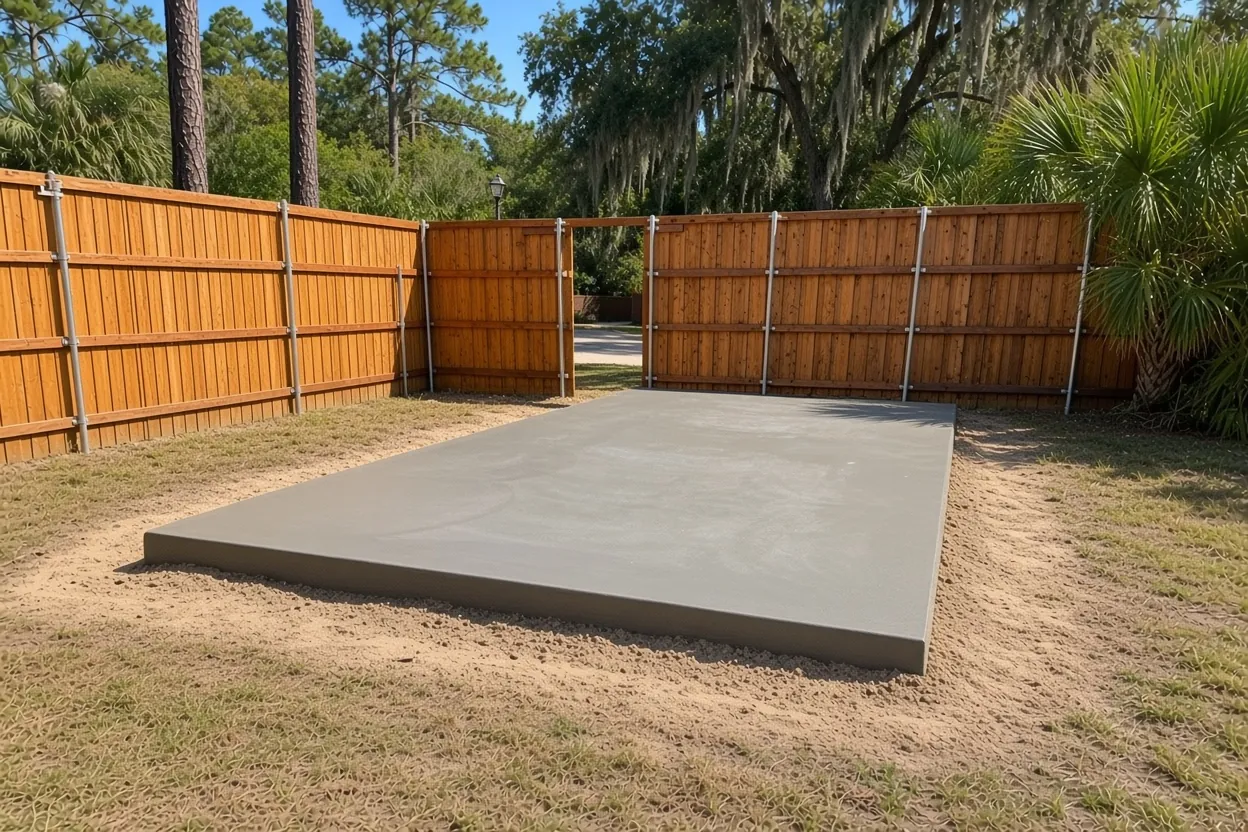
Where a shed pad can sit on a Haines City lot
Pick the spot first, then the shed. Inside city limits, Haines City's Land Development Regulations keep accessory buildings out of the front yard and the street-side yard. Side and rear yards are fair game, as long as the shed stays at least five feet off the property line and five feet from any other building on the lot. Attach the shed to the house and the code stops calling it a shed: an attached building counts as part of the principal building and has to meet the house setbacks.
That's why we measure the yard before we price the shed slab. If those five-foot lines squeeze your 12x16 into a corner a mixer can't reach, you want to find out on day one, not delivery day. Our shed and storage building slab page covers the job across Polk County, and the Haines City slab contractor page covers the permit office for bigger work.
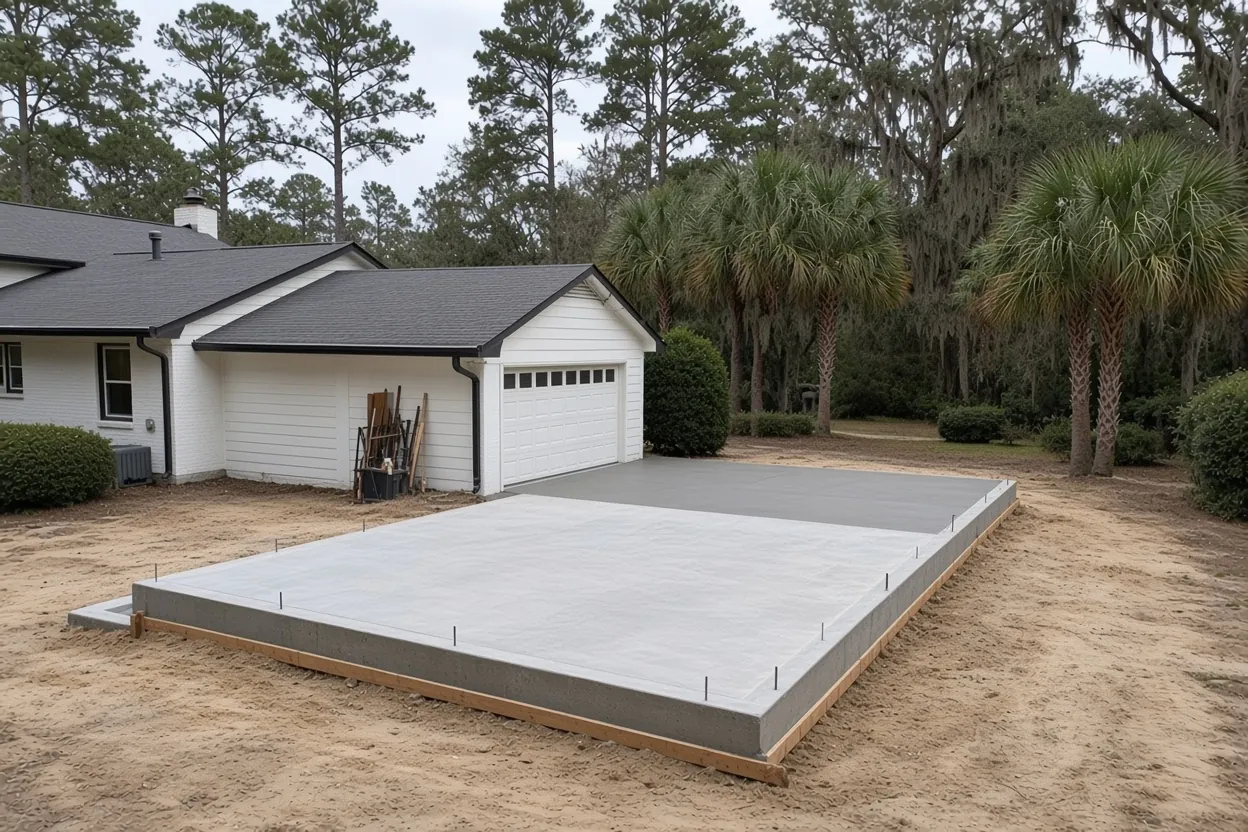
The 600 square foot ceiling on Haines City tool sheds
Start with this number. The R-1-AAA through R-1 districts allow tool and garden sheds, greenhouses and similar accessory structures as long as each one stays at or under 600 square feet, and the same language shows up in the R-2 and R-3 sections. A 20x30 storage building lands right on that line. Go bigger and you're having a different talk with the Planning Division.
Watch lot coverage too. In the R-1 family of districts, the house and every accessory building together can cover no more than 30 percent of the lot, and impervious surface caps run from 20 percent in R-1-AAA up to 50 percent in R-1. Since a slab counts against impervious area, a big pad on a small lot can run out of room even when the shed itself is legal. Don't know your district? Plug your parcel ID into the city's online Zoning Inquiry form, and it answers zoning and land use questions.
Past the city line, the county makes the call. Polk County lets only closet-size storage, 5 feet tall and 50 square feet at most, go without a permit, and its permitting page lists pre-manufactured storage buildings as permit work. On farm ground, a storage building used for the farm can fall under the state's nonresidential farm building rules; our farm building permit exemption guide walks through the test.
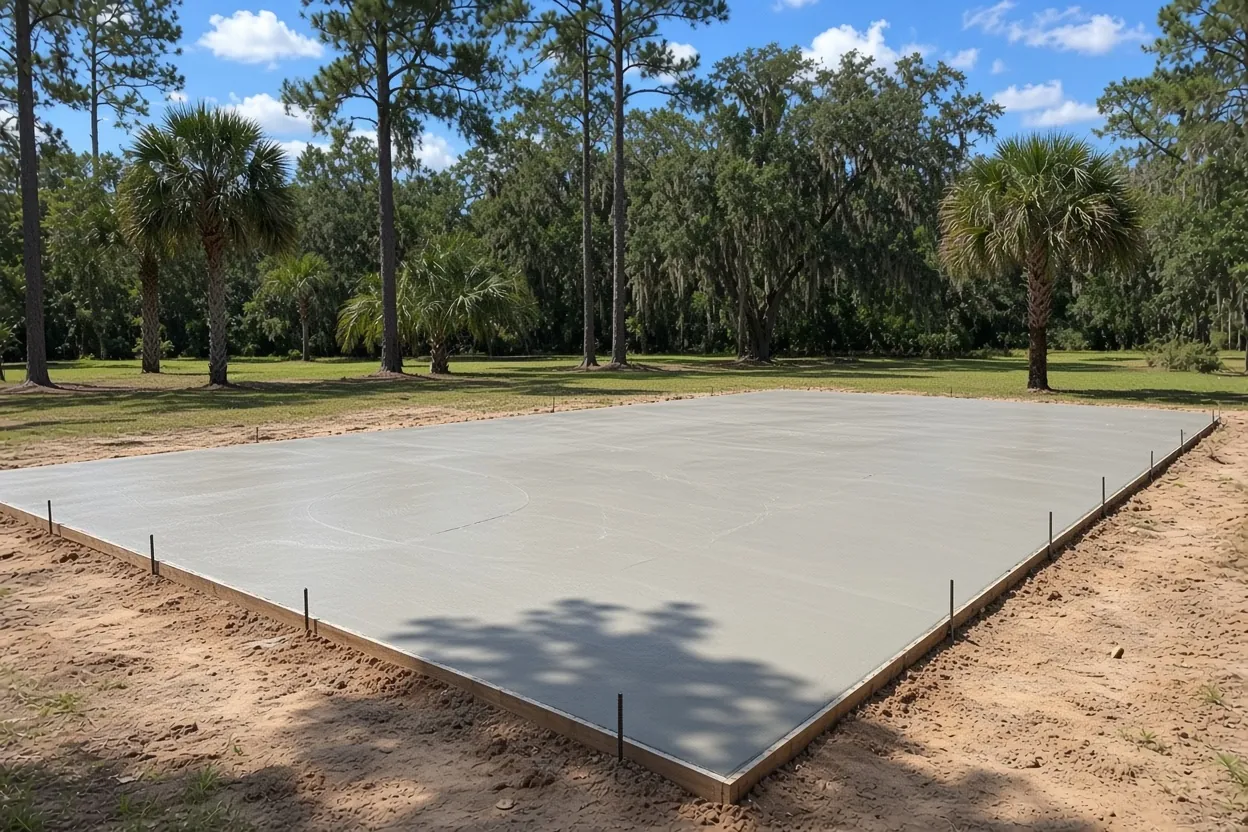
What It Costs
What shed pads run in Haines City, before we've walked your yard.
| Pad size | Per sq ft | Typical project | What moves the price |
|---|---|---|---|
| 12x16 storage shed pad (192 sq ft) | $7 to $12 | $1,344 to $2,304 (our $1,800 project floor applies) | Access to the back yard, pump or wheelbarrow |
| 16x24 shop or garden building (384 sq ft) | $7 to $12 | $2,688 to $4,608 | Thickness for a mower or cart, anchor count |
| 20x30 pad at the 600 sq ft city limit | $7 to $12 | $4,200 to $7,200 | Muck removal, fill, distance from the street |
| Shed and storage building slabs, all sizes | $7 to $12 | $1,800 to $5,000 | Our typical shed project range |
Treat these as ranges, not quotes. Your price comes in a free written estimate after we see the site, within 48 hours of the visit.
Candler sand, muck pockets and the Haines City drainage ditch
Haines City sits mostly on fast-draining sand. In a 31-point sample of NRCS soil mapping inside the 2020 city boundary, about 68 percent of points landed on Candler sand, which NRCS rates excessively drained and "not limited" for small buildings without basements. A shed pad likes that ground.
We slow down on the other third. About 6 percent of the sample was Hontoon muck, a very poorly drained organic soil that NRCS rates "very limited" for building. Another 6 percent was open water, with single points of Tavares fine sand and Adamsville fine sand. When we find muck under a pad, we dig it out and replace it with compacted clean sand, because soft organic soil can let a slab settle unevenly. Digging out a pocket doesn't trip the city's borrow-pit rules: Sec. 5.2.16.B exempts grading for a building on a lot with an issued permit, and hauling off less than 15 yards of dirt.
Flood maps tell a similar story. At those sample points about 81 percent fell in FEMA Zone X, with roughly 16 percent in Zone AE and 3 percent in Zone AH. Lake Eva, Lake Tracy and Lake Elsie, whose park sits at US 17/92 and Lake Elsie Drive, all have city parks on their shores, so check your parcel on the FEMA map before you settle the pad height. One Haines City rule worth knowing: the Haines City Drainage District, set up in 1926, maintains a ditch that meanders south on both sides of US 27, and the city keeps every accessory structure and site improvement at least 30 feet from its shoreline so maintenance crews can get through. Back fence facing that ditch? Then the pad sits 30 feet off the bank.
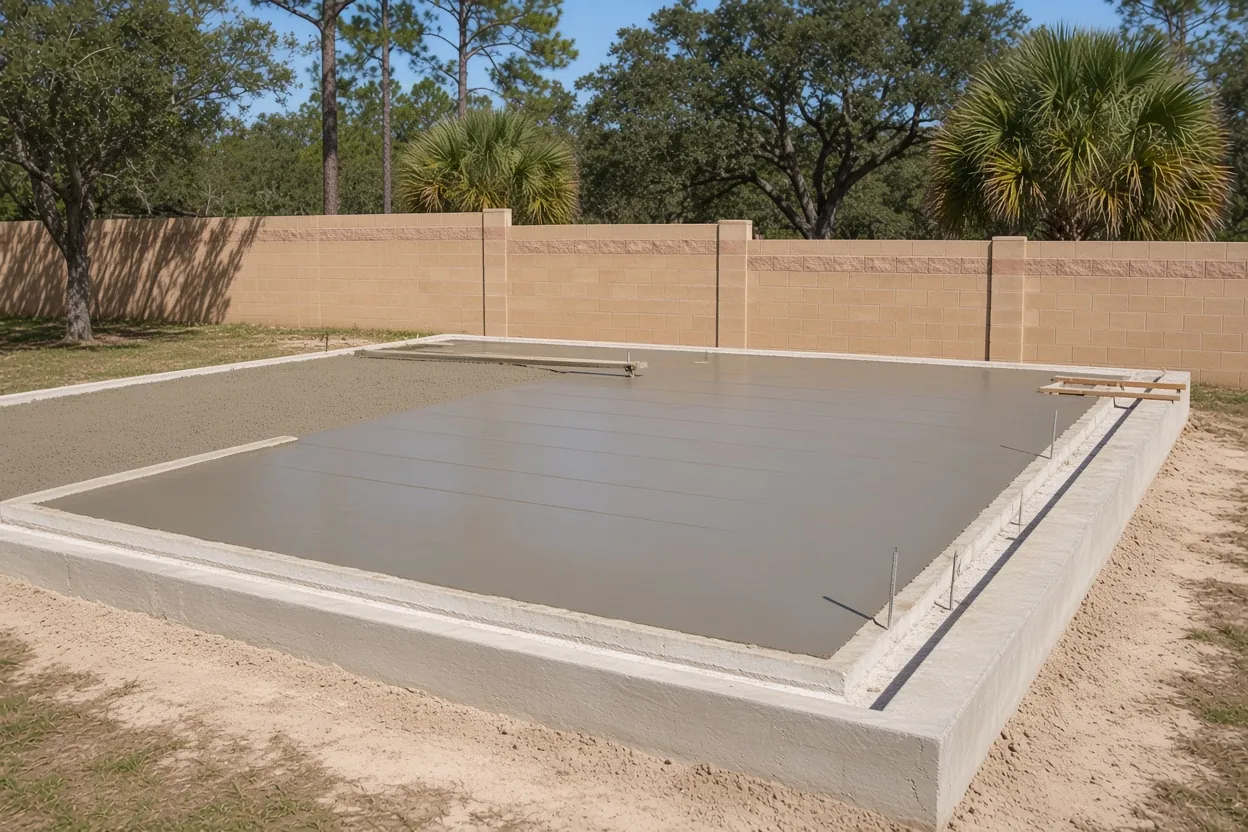
How the Job Goes
Walk the yard
We mark the five-foot lines, look for muck or a ditch bank and figure out the truck's path.
Written quote
Within 48 hours you have a written price, sized to your shed maker's drawing.
Prep and form
Topsoil comes off, we compact the sand, and forms and anchors go in to the drawing.
Pour and cure
We pour, finish and cut the joint, then keep the pad moist while it cures, all before the shed is set.
Four inches, wire or fiber, one saw cut
A shed pad is a small slab, and the code still covers it. The Florida Building Code's residential volume sets a 3-1/2 inch floor minimum, and HUD's slab guide puts typical residential slabs at about 4 inches. For a standard storage shed we pour 4 inches, and we go thicker where the plans call for a riding mower, a golf cart or a workbench full of tools.
Prep comes before any of that: the code wants vegetation and topsoil out from under the slab and any fill compacted for uniform support.
For crack control, Florida's code accepts either synthetic fiber at 0.75 to 3.0 pounds per cubic yard or 6x6 W1.4xW1.4 welded wire in the middle to upper third of the slab. NRMCA's joint rule is 24 to 36 times the thickness, about 10 feet for a 4 inch slab, with panels close to square. On a 12x16 pad, that works out to one saw cut across the middle and two 8x12 panels. A vapor retarder isn't required under unheated accessory buildings, though if the plans call for termite soil treatment, the treated soil gets 6-mil poly over it before rain can wash the chemical out.
Tie-downs, hurricane months and the 720 square foot rule
Can a shed be anchored to the slab for hurricanes? Yes, and it should be. Florida law exempts storage sheds of 720 square feet or less from the wind-borne debris impact standards, so a backyard building that size won't need impact-rated doors. Wind-load design and anchoring sit outside that exemption. The shed still has to stay put.
The anchor layout comes from the shed maker's engineered drawing or, on a site-built shed, the designer's plans. We set anchor bolts in the wet concrete, or leave the pad ready for drilled anchors once it cures, and match that drawing hole for hole. Put the anchors in the wrong spot and you break the load path from roof to ground. The design wind speed for your lot comes from the Florida Building Code's wind maps, and the city's permit application cites the 2023 Florida Building Code, 8th Edition, so that's the edition the drawing should follow.
Hurricane season runs June 1 to November 30, and a spring pour leaves plenty of time to cure the pad and bolt the shed down before then.
Haines City paperwork for a backyard storage building
Inside city limits, the City of Haines City Building Division handles plan review and inspections. Every contractor has to register with the division before a permit goes out, with a license, workers' comp or an exemption, and liability insurance. There's no registration fee. Inspections are requested through Permitting using the contractor's Web Code, and the permit holder books them.
City Code Sec. 7-2 asks for a recorded, certified copy of the Notice of Commencement before the city issues a building permit. Florida law requires recording one once the job tops $2,500. Fees are based on the job's valuation. The 2025 schedule charges a $32.59 administration fee on every permit, $32.59 for the first $1,000 of value plus $10.61 for each added $1,000, and plan review at 50 percent of the permit fee. Skip the permit and pour anyway, and the penalty is $122.17 or double the fee. The full schedule sits on the city's Applications and Fees page.
Emptying a garage while you wait? A PODS-type unit can sit on a driveway or paved surface only 14 days a year in Haines City, so line up the container, the pour and the shed delivery close together. For bigger farm buildings, see our Haines City pole barn slab page or the metal building foundation page.
Questions We Get
Should my Haines City shed pad be wider than the shed itself?
What's the largest shed I can put behind a house in Haines City?
My back yard runs along the Haines City Drainage District ditch. Can I put a shed there?
What keeps a Haines City shed on its slab when a hurricane comes through?
Does my lot near Lake Eva change how the pad gets built?
Do I need a permit in Haines City for a small prefab shed?
Sources we used
- Land Development Regulations Sec. 5.2.2 Accessory uses or structures, City of Haines City (Municode)
- Land Development Regulations Sec. 5.6.2 R-1-AAA to R-1 single family residential, City of Haines City (Municode)
- Land Development Regulations Art. 8.11 Haines City Drainage District, City of Haines City (Municode)
- Applications & Fees, City of Haines City
- Contractor Requirements, City of Haines City
- Building Permitting, Polk County Building Division
- Florida Statutes s. 553.73, Florida Legislature
- 2023 Florida Building Code, Residential, Chapter 5 Floors, ICC / Florida Building Commission (via UpCodes)
- CIP 6 Joints in Concrete Slabs on Grade, NRMCA