What Eagle Lake's permit FAQ says about a shed pad
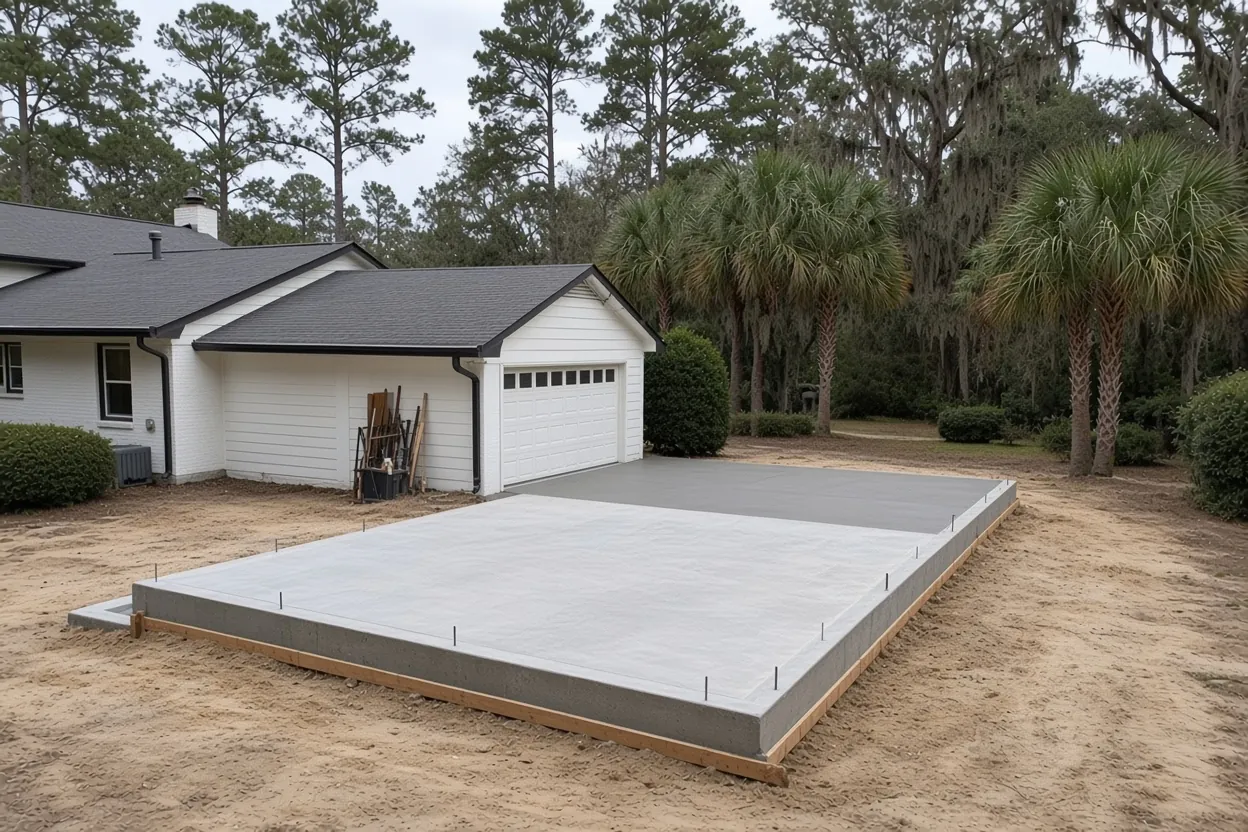
The City of Eagle Lake Building Department keeps a short Building Permit FAQ, last updated in May 2024, and two of its entries bear on a shed. One says putting up any building takes a permit. The other lists concrete slabs next to a principal or accessory structure that are meant to support a structure. A pad poured to hold a storage building fits that wording, so the shed and its slab go on the paperwork together.
The FAQ exempts just one storage unit: a prefab reach-in closet no taller than 5 feet, no bigger than 50 square feet and 250 cubic feet, with no wiring or plumbing. If you can walk into it, it's past that line. You file through the Accela portal linked from the city's building page, which is Polk County's system, and the department strongly encourages an appointment before you visit in person. Our shed slab service page covers the job across the county, and the Eagle Lake concrete slab contractor page covers barns, shops and hangars in town.
Front yard no, side or rear yes: placing the pad
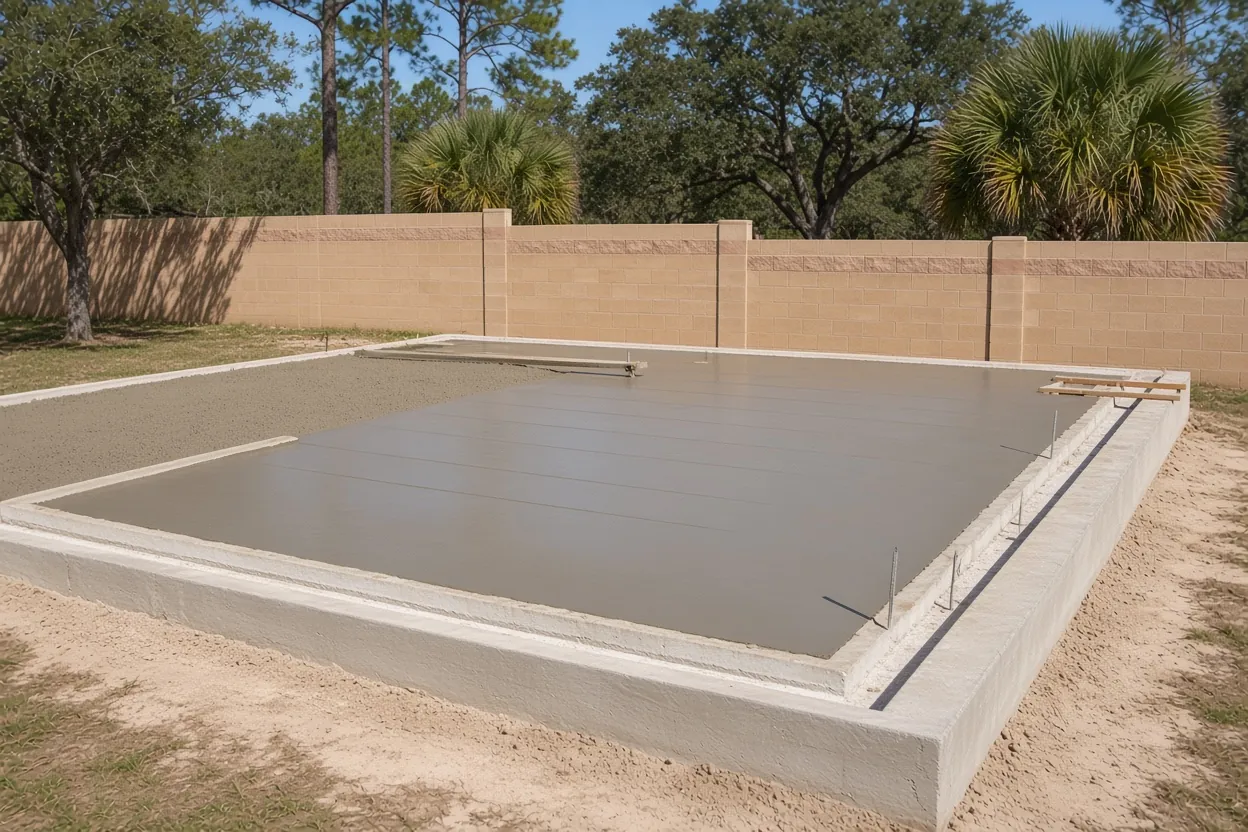
The city's Land Development Regulations lay out placement in Sec. 2.1.2.20. In a residential district, an accessory building can't go in a required front yard. A side or rear yard is fine, though not a street-side yard, and the building has to stay at least 5 feet off the property line. The second distance is the one to watch: no separate accessory building may stand within 5 feet of any other building. Tuck the shed against the back wall of the house, a garage or a carport, and you've broken it.
Two more lines in that section limit what the shed can turn into. It can't have its own electric meter apart from the house, so any power comes off the home's service. And an accessory structure can only be used together with the lot's main use; using it on its own is strictly prohibited. A building for the family's mower, bikes and hand tools fits. Renting it out as a separate shop doesn't.
Bring your survey to the site visit. We measure from the lot line and from the closest wall, stake all four corners, and keep any door ramp inside both lines.
What It Costs
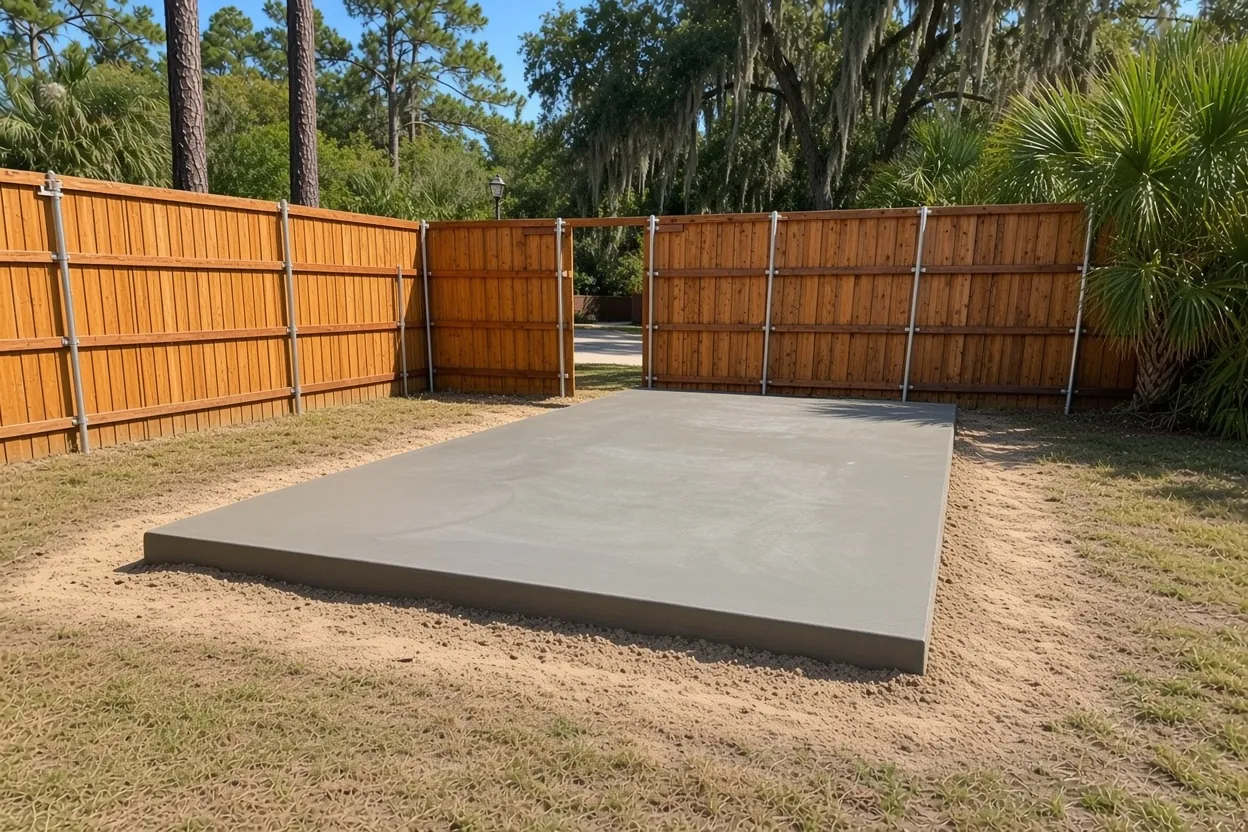
Our shed and storage building pads run $7 to $12 per square foot, and typical projects land between $1,800 and $5,000. Below is the square-foot math on sizes that fit Eagle Lake lots.
| Job | Per sq ft | Slab area math | What moves the price |
|---|---|---|---|
| 10x12 garden shed pad (120 sq ft) | $7 to $12 | $840 to $1,440 | Minimum trip and setup, so priced near the project floor |
| 12x16 shed slab (192 sq ft) | $7 to $12 | $1,344 to $2,304 | Fill on wet flatwoods sand, anchor count |
| 14x20 storage building slab (280 sq ft) | $7 to $12 | $1,960 to $3,360 | Thickness, wire or fiber, door ramp |
| 16x24 small shop pad (384 sq ft) | $7 to $12 | $2,688 to $4,608 | Truck reach to the back yard, saw cuts |
| Typical Eagle Lake shed project | $7 to $12 | $1,800 to $5,000 | Size, site prep, anchors |
These are ranges, not a quote. Every pad takes a truck, forms and a finishing crew, so a very small slab prices toward the low end of the project range, not the bare per-foot math. You'll have your free written estimate within 48 hours of the site visit.
Rear setbacks and paved-area caps by zoning district
Beyond those 5 foot rules, your zoning district adds numbers of its own, listed in Table 2.5.1.10. In ST-30, ST-20 and ST-14, the rear setback is 30 feet for the house and 15 feet for an accessory structure. In Suburban Estates, SE-1 and SE-2, it's 50 feet for the house and 25 feet for an accessory building. On a deep SE lot, that puts the shed well in from the back fence.
The same table caps impervious surface, meaning the share of the lot under roofs, slabs and pavement: 50 percent in SE-1 and SE-2, 55 percent in RS-1, 60 percent in RS-2 and the ST districts, and 70 percent in RG. A shed pad counts toward that total, along with the house, the driveway and any patio. On a small lot with a wide driveway already in, a 16x24 pad can be the piece that tips it over. Most residential districts also cap structures at 35 feet, so height won't be what limits a shed.
The city's zoning map, last updated in March 2022, is posted on its website. Find your parcel's district there before you settle on a shed size, then confirm both the setback and the coverage figure with the building desk. A storage building serving a working grove or pasture can be a different case under state farm-building law, though Eagle Lake's Code Sec. 7.5-121 still holds a building exempt from the Florida Building Code to ASCE 24 flood-resistant construction. Ask the building desk before you count on the exemption. Our farm building exemption guide lays out the test, and the Eagle Lake pole barn slab page covers larger farm buildings.
How the Job Goes
Yard walk with your survey
We measure 5 feet off the lot line and 5 feet off every building, and note the parcel's zoning district.
Quote in writing
Within 48 hours, you get the pad size, thickness, anchor plan and price on paper.
Permit and forms
After the permit holder has the permit, we set forms square to the maker's footprint and place anchors per the drawing.
Pour and cure
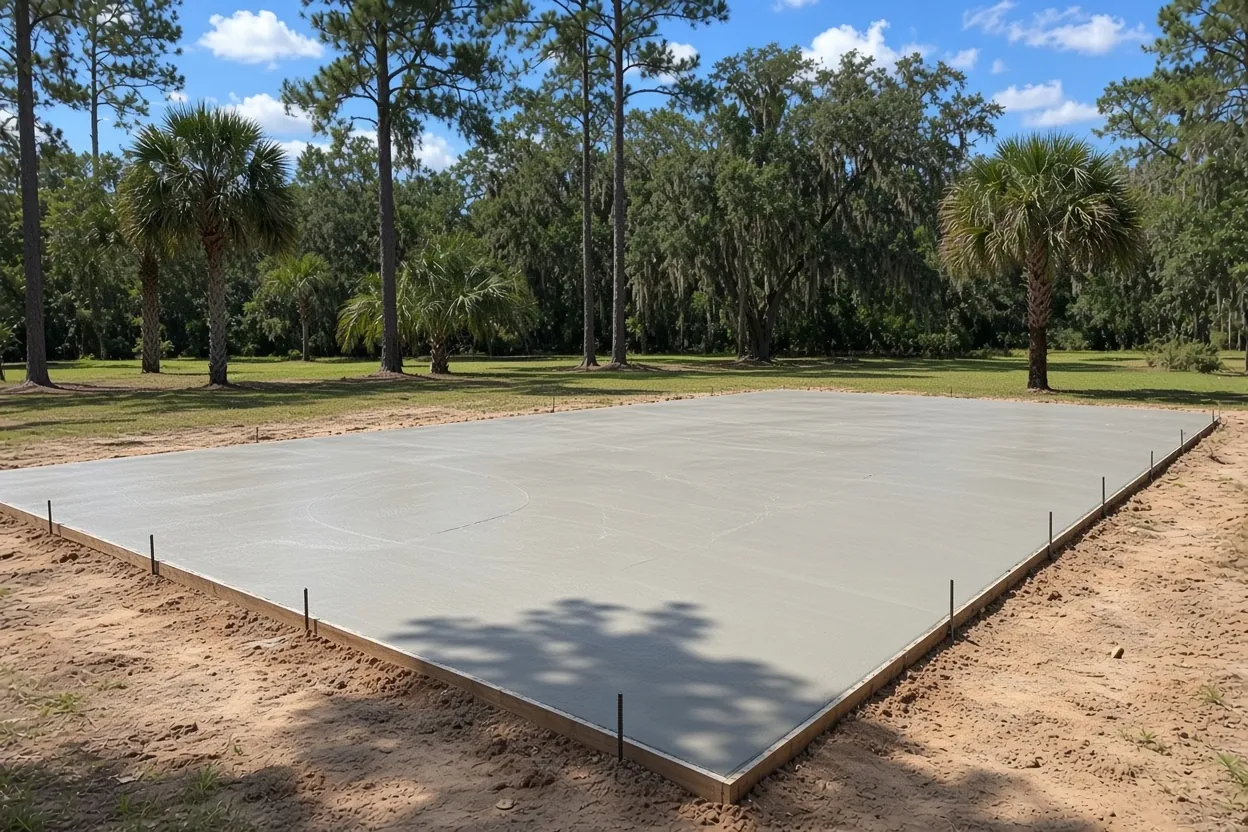
We pour, finish and keep the slab damp through the cure. Then you schedule the shed delivery.
Lake McLeod subdivisions, Candler sand and the wet flatwoods
Water takes up a big share of Eagle Lake. Of 34 soil survey points sampled inside the 2020 Census boundary, 52.9 percent fell on open water. The dry points split among a few sandy soils that behave differently under a pad. Candler sand and Candler-Urban land drain fast. Tavares fine sand drains moderately. Smyrna and Myakka fine sands are poorly drained, with the water table about 15 centimeters (roughly 6 inches) down, and the survey rates them very limited for dwellings. Pomello-Urban land showed up too.
On fast-draining Candler sand, prep is simple: strip the sod and roots, compact the sand, set forms and pour. On wet flatwoods sand, we build the pad up with clean fill and crown it so rain sheds away from the doors rather than pooling at the threshold. Florida's residential code caps fill under a slab at 24 inches of clean sand or gravel unless the building official approves more, so pad height gets settled on the walk, before the price.
On a lake lot, check the flood map. At the same sample points, FEMA's map showed 61.8 percent Zone AE and 38.2 percent Zone X, with most AE hits on the lakes and their edges. Live in the planned housing tracts south and east of Lake McLeod, or on a lot backing onto Eagle Lake itself? Pull your parcel on the FEMA map before you choose the spot.
Anchor points and the storm calendar
A shed is tall walls on a light frame, and in a blow the slab is the only thing keeping it in place. Under s. 553.73(10)(h), Florida exempts storage sheds of 720 square feet or less that aren't built for people to live in from the wind-borne debris impact standards. That exemption leaves wind load and anchoring untouched. The design wind speed comes from the Florida Building Code wind maps, chosen by the building's risk category under Section 1609.3, and it belongs on the shed maker's or engineer's drawing. We cast anchors where that drawing places them instead of picking a number ourselves.
Timing matters as well. Hurricane season runs June 1 to November 30, and the National Hurricane Center puts the peak around September 10. The National Weather Service gives this part of Florida a rainy season from May 25 to October 10. We book summer pours for the morning, since a hard rain on fresh concrete can wash the surface. If the shed company can deliver in winter or spring, the pad is easier to schedule.
Send us the anchor sheet before forms go down: bolt spacing, edge distance and anchor type. We check each spot against it while the forms are still open.
Thickness, crack control and curing for a backyard pad
Florida's residential code sets 3-1/2 inches as the minimum for a slab on ground, and HUD's building guide puts typical residential slabs near 4 inches. That handles a garden shed with a push mower and shelving. If the building will hold a riding mower, a loaded bench or a parts rack, tell us, and we pour to whatever the plan calls for.
The code offers two crack-control methods that let a slab skip contraction joints, provided the owner accepts random cracks: synthetic fibers in the mix, or 6x6 welded wire held in the middle to upper third of the slab. We still saw-cut any pad much past 10 feet. NRMCA's spacing rule is 24 to 36 times the thickness, so a 4 inch pad gets a joint every 8 to 12 feet, cut at least a quarter of the way through, with panels close to square. On a 12x16 pad, that's one cut across the middle.
Unheated accessory buildings like a storage shed don't require a 6-mil vapor retarder, but if the soil gets a termite treatment, plastic goes over the treated ground. After the pour, we keep the slab damp or covered for 3 to 7 days. NRMCA notes that concrete left to dry out can lose as much as half its potential strength.
Questions We Get
How much bigger than the shed should an Eagle Lake shed slab be?
Can a shed on an Eagle Lake pad be anchored for hurricanes?
Does a small prefab shed in Eagle Lake need a permit?
Can my Eagle Lake shed have its own electric meter?
How far from the back fence does a shed go on an SE lot in Eagle Lake?
Is the ground near Lake McLeod too wet for a shed slab?
Sources we used
- Building, City of Eagle Lake
- Building Permit FAQ (updated 05/22/2024), City of Eagle Lake
- LDR Sec. 2.1.2.20 Accessory uses or structures, City of Eagle Lake (Municode)
- LDR Sec. 2.5.1.10 Dimensional tables, City of Eagle Lake (Municode)
- Map Direct Program Support, Florida SSURGO soils layer, Florida Department of Environmental Protection (NRCS SSURGO data)
- National Flood Hazard Layer, FEMA
- Florida Statutes s. 553.73 Florida Building Code, Florida Legislature (Online Sunshine)
- CIP 6 Joints in Concrete Slabs on Grade, National Ready Mixed Concrete Association
- Code Sec. 7.5-121 Design and construction of buildings exempt from the Florida Building Code, City of Eagle Lake (Municode)