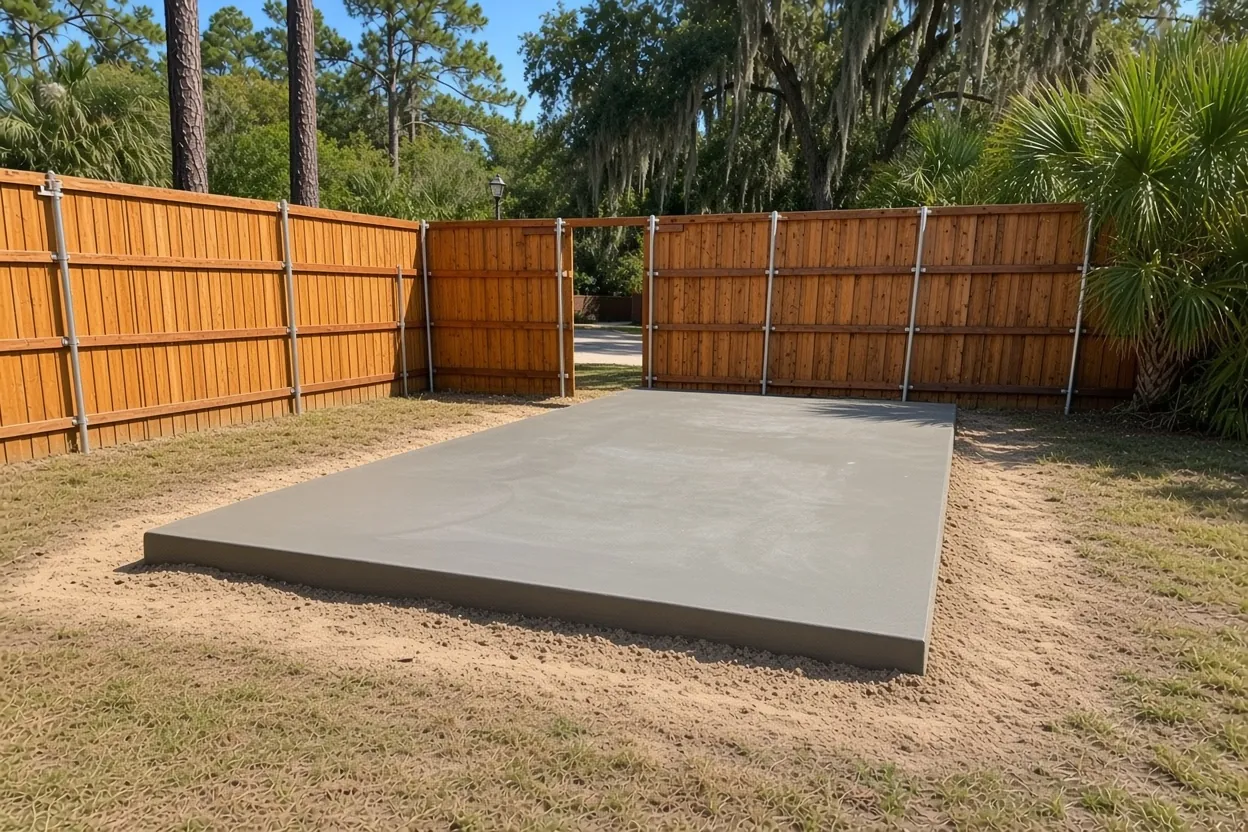
A Lake Wales mailing address on a county shed pad
Waverly is a census-designated place of 661 people (2020 Census), not a city, and that decides who signs off on your shed. A 135-point grid laid over the Waverly CDP put 134 points outside every city limit on Polk County's GIS map. One point landed inside the City of Lake Wales, so a parcel right at that edge is worth a quick look. The mail muddies it. Of 440 parcels wholly inside the CDP, 282 list Lake Wales as the property city, 155 say Waverly and 3 say Dundee. The address on the envelope isn't the permit office.
On nearly every Waverly lot, the shed permit goes through the Polk County Building Division in Bartow. The county lists pre-manufactured storage buildings as permit work, and slabs poured to hold up a structure too. Our shed and storage building slab page covers the whole job county-wide, and the Waverly slab contractor page covers barns, shops and hangar floors out here.
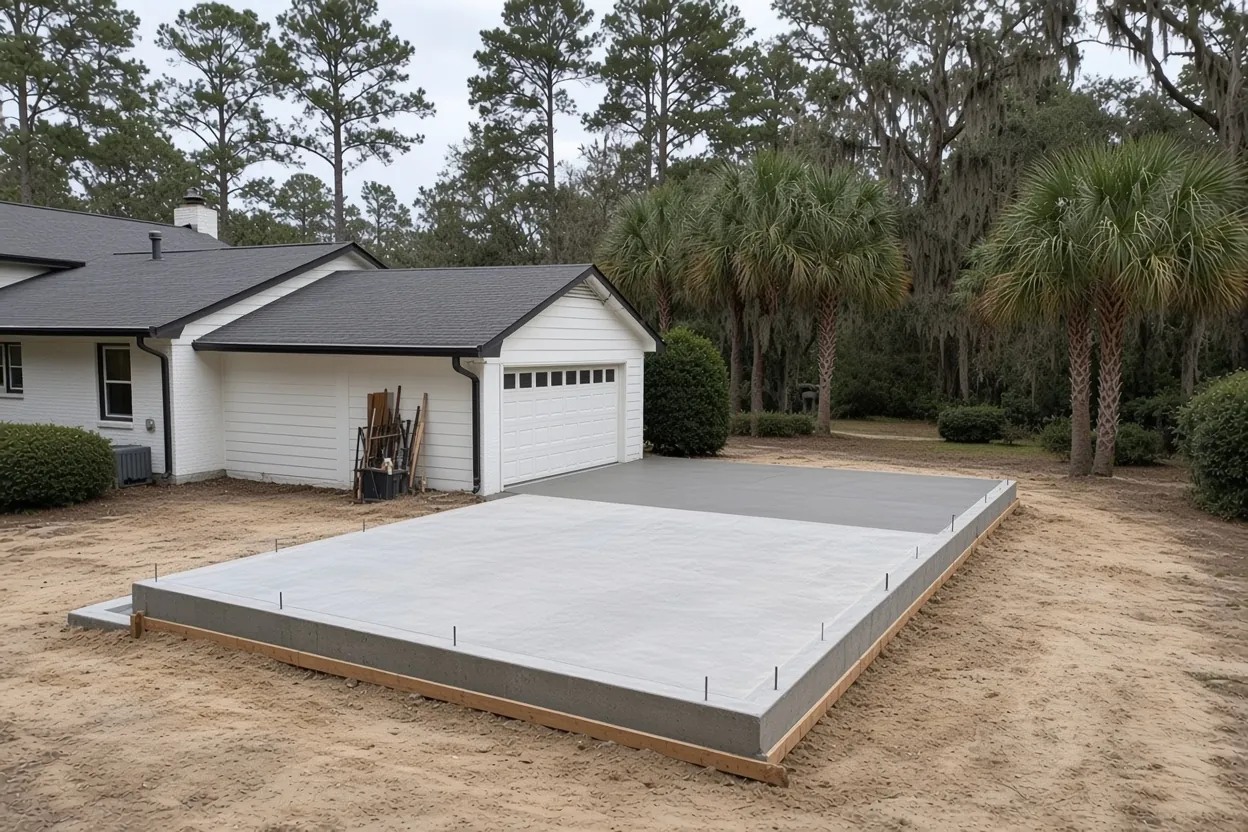
House on the lot first, shed beside or behind it
Under Polk's Land Development Code, Sec. 209, a building permit has to be pulled before an accessory structure goes up, and a permitted principal use, like your house, must already be on the parcel. The one carve-out is a bona fide agricultural structure, and our farm building permit exemption guide explains that test. If you bought one of the 78 vacant residential parcels inside the CDP, the shed waits for the house. The same section puts accessory buildings in the side or rear yard.
Sec. 209.D.2 adds a rule that's easy to miss. No accessory structure can sit in a required buffer, a right-of-way or an easement unless the easement holder approves. A pad that creeps over a utility strip at the back of the lot can stall the permit, so we lay out forms from the survey lines, not the fence. Polk also says every slab has to meet the minimum setbacks from property lines and easements, plus the drainage rules. Ask the Building Division for the numbers on your zoning before we stake anything.
On lots of two acres or more, Sec. 209.G lets an accessory building reach 2,000 square feet or 150 percent of the house's floor area, whichever is greater, without a variance. That leaves room for a big storage building. Most Waverly homes, 236 parcels, fall in the county's "SFR up to 2.49 AC" class, so check which side of the two-acre line you're on before you size anything bigger than a backyard shed.
What It Costs
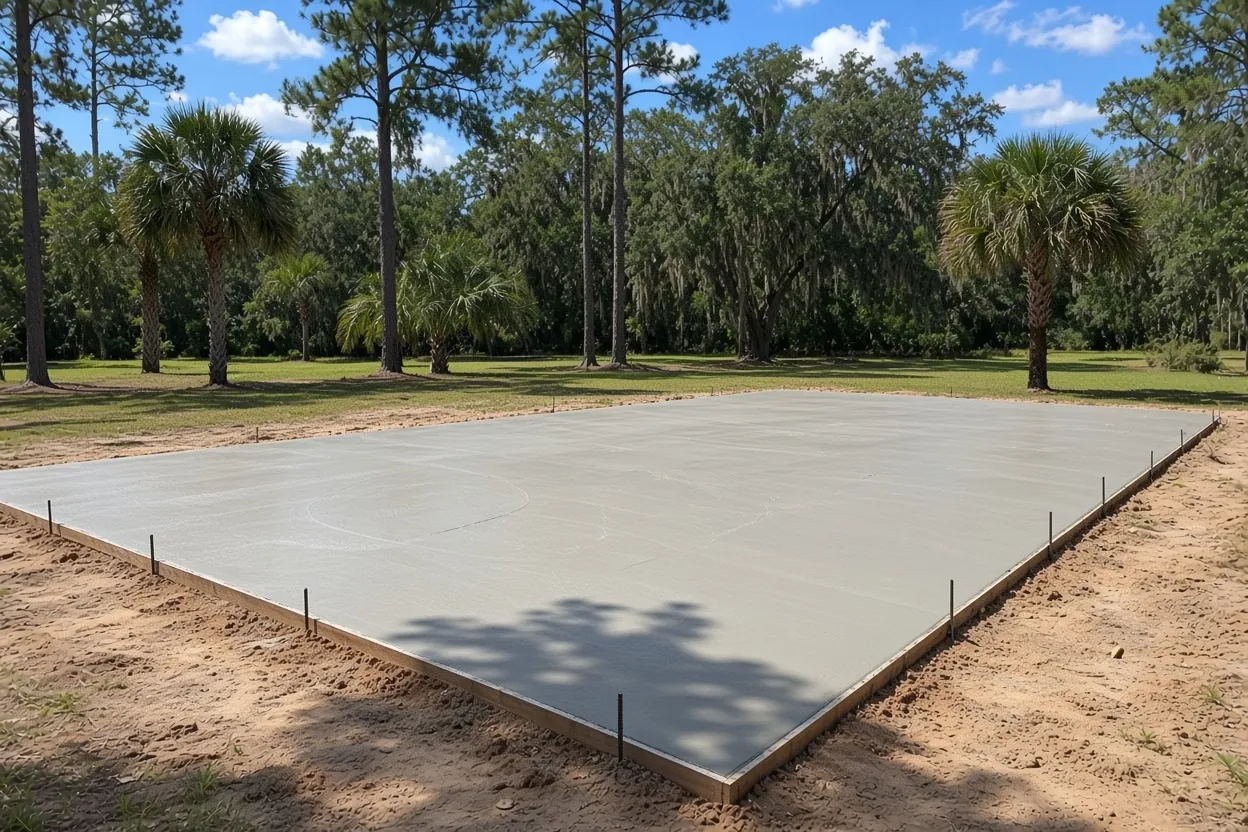
Our shed and storage building slabs run $7 to $12 per square foot, and typical projects land at $1,800 to $5,000. Here's the per-foot math at sizes that fit Waverly yards and acreage.
| Job | Per sq ft | Slab area math | What moves the price |
|---|---|---|---|
| 12x20 storage shed pad (240 sq ft) | $7 to $12 | $1,680 to $2,880 | Clean sand fill on a low yard, anchor count |
| 12x24 pad, one saw cut (288 sq ft) | $7 to $12 | $2,016 to $3,456 | Fiber or wire, pad height in a flood zone |
| 16x24 storage building on two acres or more (384 sq ft) | $7 to $12 | $2,688 to $4,608 | Thickened edges, truck reach to the pad |
| Typical shed or storage building project | $7 to $12 | $1,800 to $5,000 | Size, thickness, fill, anchors |
Zone AE around Lake Venus and the low end of the yard
Read Waverly's flood map carefully. At 98 sample points inside the CDP, the FEMA National Flood Hazard Layer showed 48 percent Zone AE, 48 percent Zone X, 3.1 percent in the 0.2 percent annual chance band and 1 percent Zone A. One point in the north part of Waverly mapped AE with a base flood elevation of 121.4 feet. Lake Venus sits inside the CDP, and 15 parcels carry a lakefront home code. The lake has some local history behind it: it's named for the daughter of F.W. Ohlinger, one of the men who homesteaded here in the 1880s.
For a shed, that means two things. First, pull your parcel's flood zone before you choose a spot. If part of the yard maps X and part maps AE, put the shed on the X side. Second, Polk's flood section, Sec. 630, sets the lowest floor of a building in a flood zone at least one foot above base flood elevation. Polk LDC Sec. 630.N.6 also allows a one-story, freestanding storage building of 600 square feet or under to be placed at grade in a flood zone with flood openings built in, so check with the county on whether your shed counts. Ask the Building Division how that applies to an accessory shed on your lot before you order the shed. The answer changes how high we set the pad and what the inspector will check.
We'd rather settle that on the site visit than on inspection day.
How the Job Goes
Walk the yard
We see where water sits, find your survey lines and talk through the shed spot against the flood map.
Quote in 48 hours
Pad size, thickness, fill, reinforcement and anchor layout, in writing and priced from our ranges.
Base and forms
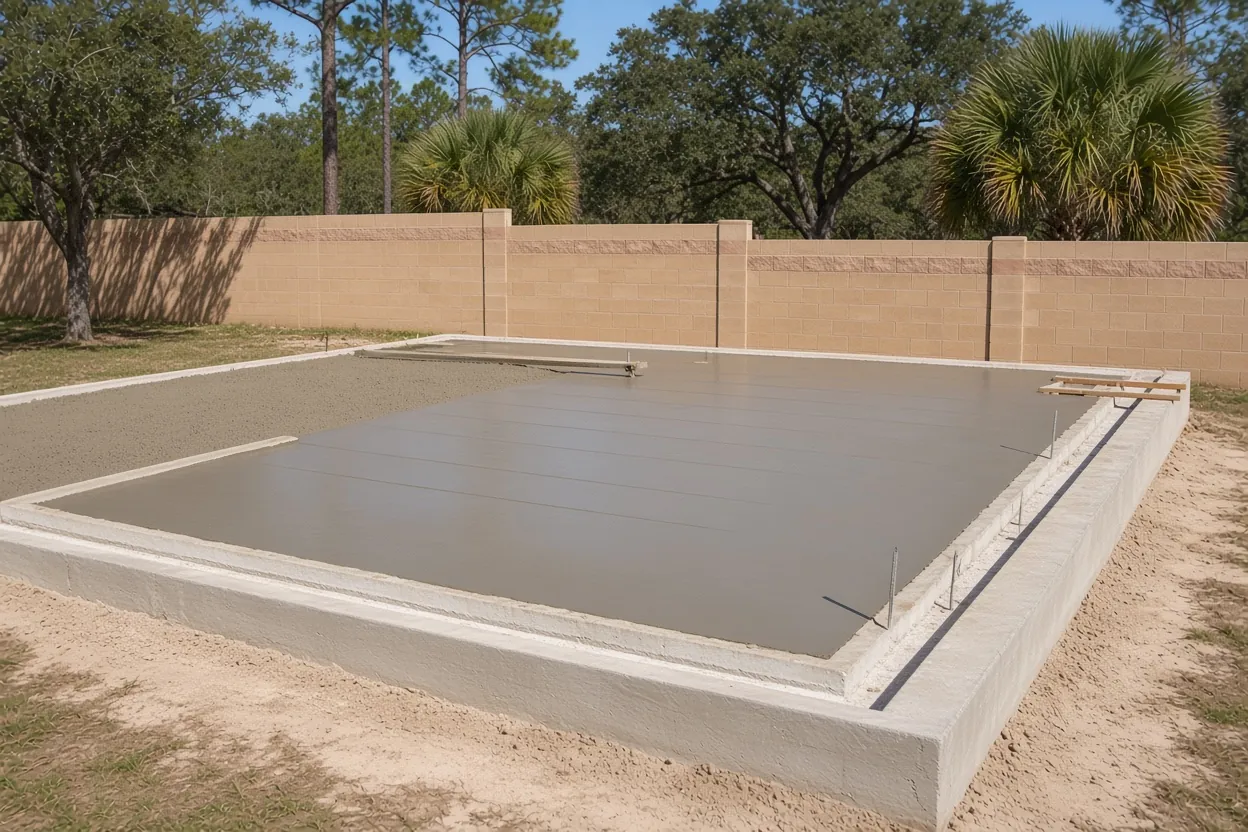
Topsoil comes off, clean sand goes down and gets compacted, and forms go in square to the maker's footprint with the anchors placed.
Pour and cure
In summer we pour in the morning, then the pad stays wet or covered until it's ready for the shed delivery.
Immokalee sand, mucky depressions and a shed pad that stays dry
Most of Waverly sits on wet sand. In the NRCS soil survey, read at the same 98 points, about 71 percent landed on soil units rated very limited for dwellings without basements. Immokalee sand led at 16.3 percent, followed by Basinger mucky fine sand (depressional) at 11.2, Winder fine sand (depressional) at 9.2, Smyrna and Myakka fine sands at 9.2, Samsula muck at 7.1 and Pompano fine sand at 6.1. Every one of them is poorly to very poorly drained, with seasonal high water listed at 0 to 31 centimeters, about a foot or less. Only about 10 percent mapped as Tavares, Pomello or Candler, the sandier units rated not limited.
Here's what that does to a shed pad. The code wants all vegetation, topsoil and foreign material stripped out from under the slab. Fill under it has to be compacted for even support, and without approval it tops out at 24 inches of clean sand or gravel, or 8 inches of earth. On a low yard we haul in clean sand, compact it, and set the pad high enough that rain runs off instead of pooling at the edge.
The Polk County Water Atlas notes that compacted soil soaks up less water, so standing water can show up after a storm. Keep the truck path and the shed apron out of the spot where your yard already ponds.
Anchors cast in for the June to November storm months
The Atlantic hurricane season runs June 1 to November 30 and peaks around September 10. A storage building that isn't tied to its slab has nothing keeping it there in a hard wind.
Florida law exempts storage sheds of 720 square feet or less of floor area, not built for people to live in, from the mandatory wind-borne debris impact standards. That break is narrow. It covers impact standards and nothing else, so the shed still has to be designed for wind and still has to be anchored.
Design wind speed comes from the Florida Building Code wind maps in Section 1609.3, chosen by the building's risk category. It belongs on the shed maker's or engineer's drawing with the anchor layout, and that drawing is what we pour to. We set the bolts, straps or embeds where the sheet shows them, check spacing against the drawing while the forms are still up, and hold them plumb while the concrete goes in and gets finished. If the drawing calls for a thickened edge under the anchors, that goes in the forms too.
Bring the drawing to the site visit. If the shed company hasn't sent one, ask for it before you book the pour date. Guessing at an anchor layout is how a pad ends up with bolts in the wrong place.
Four inches for a mower shed, more under a tractor bay
The Florida Building Code Residential sets a 3-1/2 inch minimum for slab-on-ground floors, and HUD's recommended practices put residential slabs at about 4 inches. That's enough for garden gear, a riding mower and shelving. A storage building that will hold a compact tractor or a loaded trailer gets a thicker pad, and the plan sets it.
For crack control, the code accepts synthetic fiber or 6x6 W1.4xW1.4 welded wire, with the wire held in the middle to upper third of the slab. NRMCA spaces contraction joints 24 to 36 times the thickness, never past 15 feet, with no panel longer than 1.5 times its width. On a 4 inch pad that means joints every 8 to 12 feet. Saw a 12x24 storage building pad once across the middle and you get two 12x12 squares.
Garages, utility buildings and other unheated accessory structures don't need a vapor sheet under the residential code, so a plain storage shed can skip it. If you plan to air-condition the building later, tell us now. If your permit calls for a termite soil treatment, Florida wants the treated soil covered with 6-mil plastic, and rain on it before the plastic goes down means treating it again.
The local rainy season runs May 25 to October 10. We pour summer pads in the morning and keep them wet or covered for the 3 to 7 days NRMCA recommends, because concrete left to dry out can lose up to half its potential strength.
Questions We Get
My Waverly address says Lake Wales. Do I go to Lake Wales City Hall for the shed permit?
Can I put a storage shed on a vacant Waverly lot before the house is built?
How much bigger than the shed should the slab be on a Waverly lot?
Can a shed on a Waverly slab be anchored for a hurricane?
My yard near Lake Venus maps in flood zone AE. Can I still put a shed there?
Is any shed small enough to skip the Polk County permit in Waverly?
Does the soil in Waverly mean my shed pad needs fill?
Sources we used
- Building Permitting, Polk County Building Division
- Polk County Land Development Code, Sec. 209 Accessory Structures, Polk County (Municode)
- Polk County Land Development Code, Sec. 630 Flood Hazard Management, Polk County (Municode)
- National Flood Hazard Layer, FEMA
- Florida SSURGO layer (NRCS soil survey), Map Direct, Florida Department of Environmental Protection
- Florida Statutes s. 553.73 Florida Building Code, Florida Legislature (Online Sunshine)
- 2023 Florida Building Code, Residential, Chapter 5 Floors, ICC / Florida Building Commission (via UpCodes)
- CIP 6: Joints in Concrete Slabs on Grade, National Ready Mixed Concrete Association