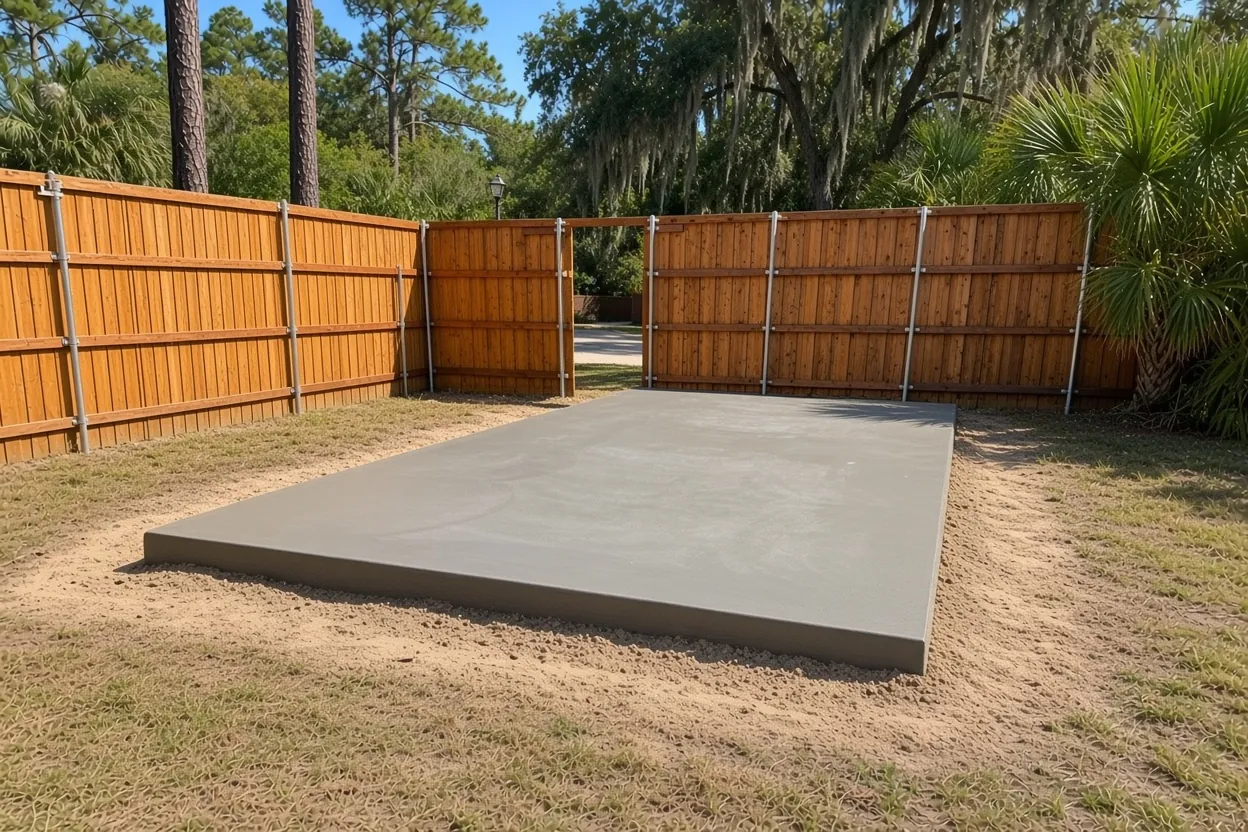
Lot size picks the shed before the shed picks the slab
Picking the shed first feels natural. In Lakeland, pull out your deed instead. The city's zoning table ties a storage shed's size to the size of the lot under it. Once you have that number, the concrete shed pad falls into place: the footprint, the anchor layout and the price.
Here's what this page walks through: the shed caps and setbacks, the permit file, the lakes a shed has to stay away from, the two kinds of ground under city yards, and what a pad costs at each allowed size. The whole job across the county is on our shed and storage building slab page. Every slab type we pour in town starts at our Lakeland concrete slab contractor page.
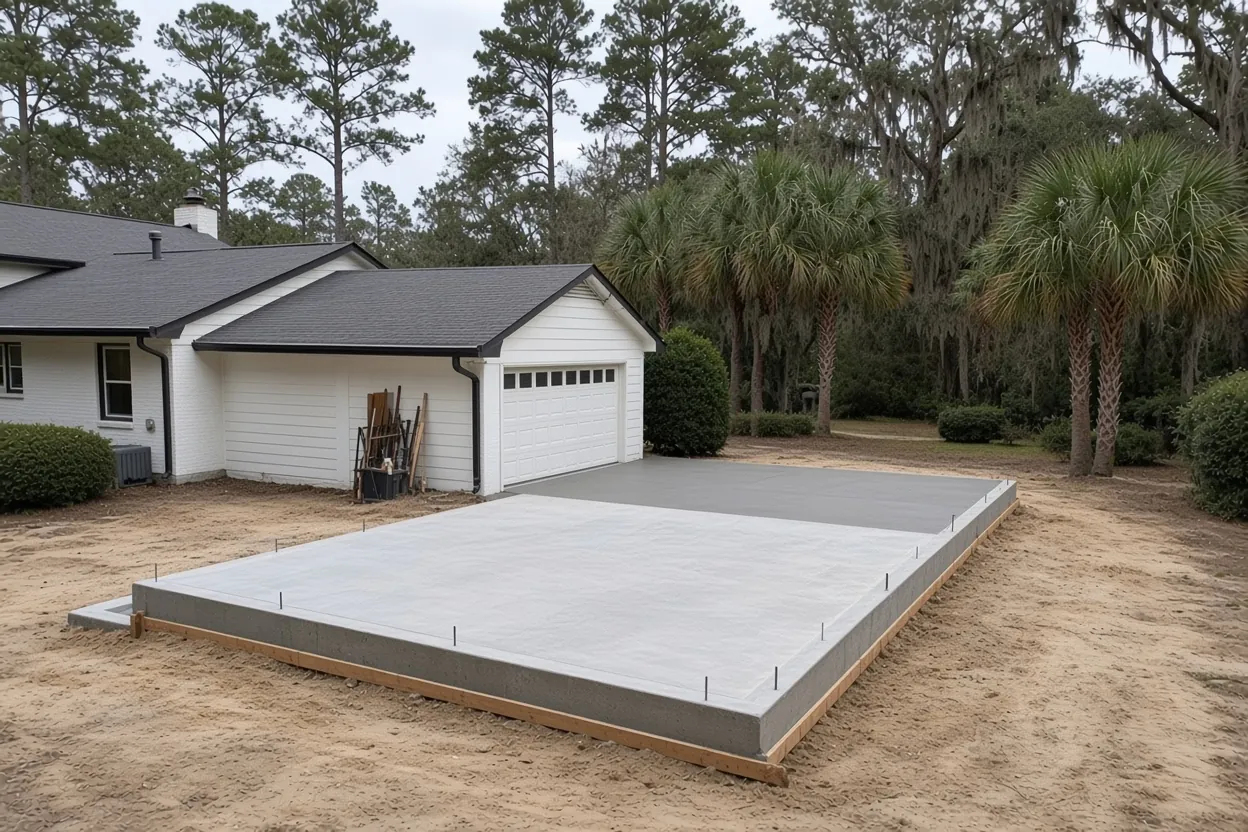
Lakeland's 200 and 400 square foot shed caps
Table 4.3-4 of the Lakeland Land Development Code calls a utility shed or storage building an accessory structure and sizes it by the lot. On a single-family or two-family lot under 1 acre, you get up to two sheds of 200 sq ft each. At 1 acre or more, the cap climbs to 400 sq ft, with the same limit of two. Add up every accessory structure under roof on the lot, and the total can't pass 10% of the lot's square footage. Height stops at 12.5 ft.
That section also sets these rules:
- Setbacks. 5 ft from the side and rear lines, and 5 ft behind the front face of the house. In the RA-3 and RA-4 sub-districts the minimum drops to 3 ft.
- House first. The main house goes up first, and the shed shares its lot.
- No containers. Outside temporary and construction uses, a trailer, a vehicle or an overseas shipping container can't stand in as a storage building.
- Power from the house. The shed can't have its own electric meter. Power has to run from the house's main panel to a sub-panel.
Want more than 200 sq ft on a smaller lot? Detached garages, carports and pole barns sit in their own 600 sq ft row of the table. Ask Planning staff if your building qualifies, then check our Lakeland pole barn slab page and the pole barn slab cost guide for the bigger floor.
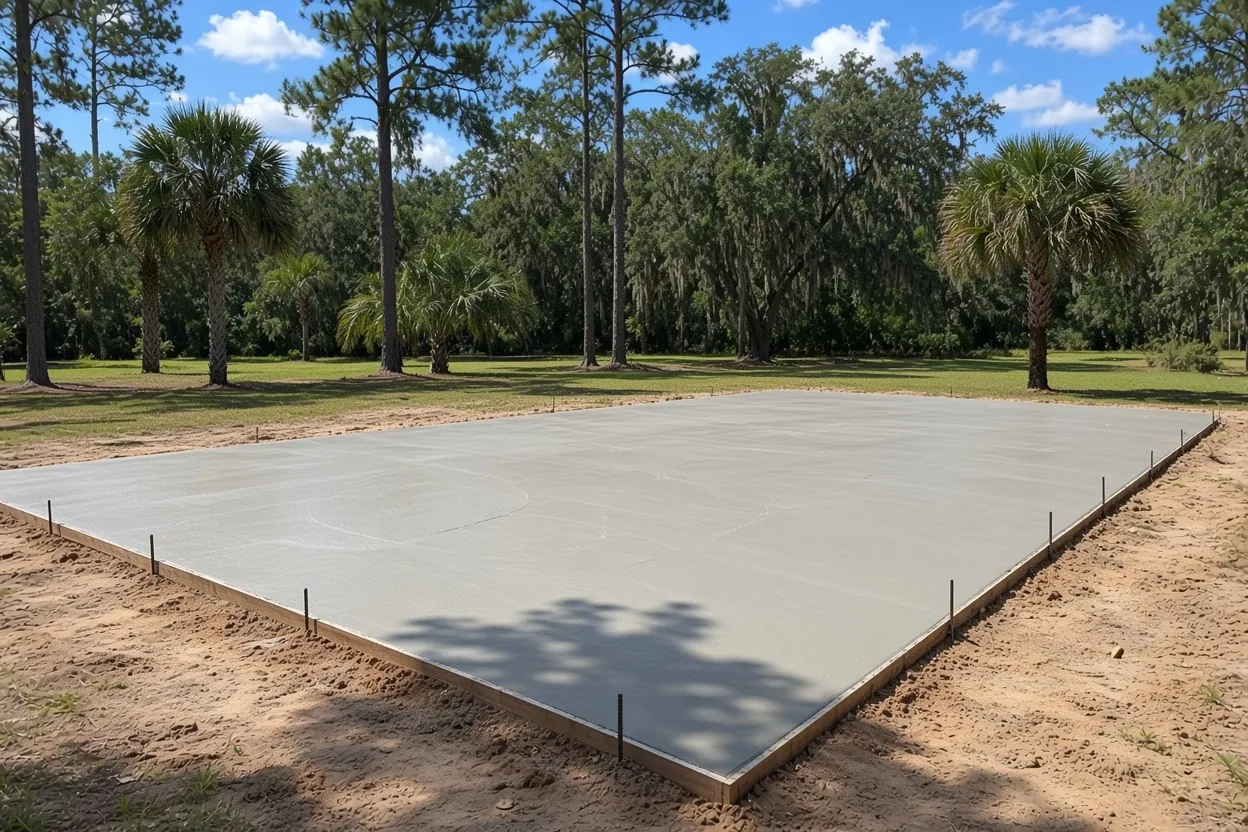
What It Costs
What shed and storage building slabs run with us, before we've seen your yard.
| Job | Per sq ft | Typical project | What moves the price |
|---|---|---|---|
| Shed or storage building pad | $7 to $12 | $1,800 to $5,000 | Pad size, raising a wet yard, anchors, access |
| Detached garage or workshop slab | $7 to $12 | $4,500 to $15,000 | Thickened edges, apron, heavier loads |
Treat these as ranges, not a quote. Your real number comes in a free written estimate after we see the site, sent within 48 hours of the visit.
What Lakeland's Building Inspection Division wants in a shed permit file
Every accessory building in the City of Lakeland needs a building permit, storage sheds included. The city's permit requirements page allows a single exception: an unattached shed 5 ft tall or less and 250 cubic ft or less. If you can walk into it, it needs a permit, and the slab goes in that file.
What the file holds depends on how your shed shows up:
- Pre-manufactured shed. The maker's engineered drawings, with the shed's height and its anchoring system. We form the pad straight off that anchor sheet.
- Shed built on site. Plans signed and sealed by an architect or engineer, a site plan with setbacks, and Florida Product Approval numbers.
- Bigger jobs. Florida requires a Notice of Commencement to be recorded once the job passes $2,500, and Lakeland wants a copy of the recorded notice before the first inspection when it passes $5,000. The notice is recorded with the Polk County Clerk of Courts.
You apply through iMS. Sealed plans go in through ePlan and nowhere else. In a historic district, the Historic Preservation Board approves the shed before you apply. The permit holder books inspections, and we let you know when forms and anchors are ready. Past the city line, Polk County takes over and exempts only closet-size storage of 50 sq ft or less.
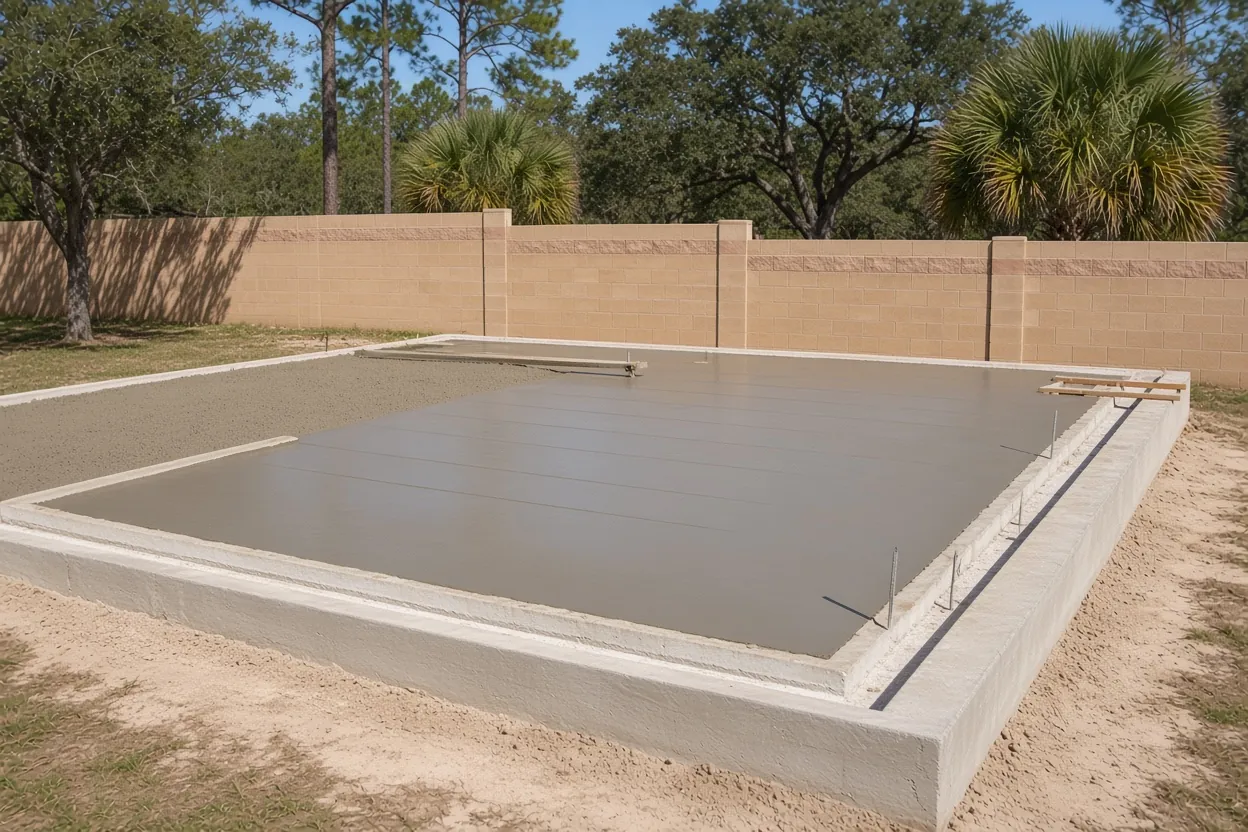
How the Job Goes
Check the lot and the cap
Before anyone talks shed sizes, we confirm the lot size, the 5 ft setbacks and any lake line.
Read the anchor drawing
The slab edges and every embed spot come straight off the maker's or engineer's anchoring sheet.
Strip, fill and form
We pull vegetation and topsoil, raise wet yards with clean compacted fill and set the forms square.
Pour and cure
Concrete goes in early in the day. We cut the joint, set the anchors and keep the pad damp through the cure.
Lake Parker, Lake Hollingsworth and the shoreline setbacks
Lakeland has lakes all over town, and two separate rules keep sheds off the banks. Under LDC 6.4, a house or an accessory building has to stay at least 50 ft landward of the ordinary high-water line on 11 protected lakes: Beulah, Bonnet, Bonny, Crago, Gibson, Hollingsworth, Holloway, Hunter, Morton, Parker and Wire. You can ask for an administrative variance, but plan on the 50 ft line.
The second rule lives in the city code. City Code Sec. 58-1 bans any building or shed on the shores of Lake Mirror, Morton, Wire, Beulah, Hunter, Hollingsworth, Bonny and Parker where a hard-surfaced road borders the lake. If a paved road runs along the shore near your lot, ask the city before you plan a shed on the water side of it.
Lake Parker alone spans 2,109 acres and Lake Gibson 490, which is a lot of shoreline to measure from. Flood maps are your other check. In a sample of city points on FEMA's flood layer, about 81% fell in Zone X, the rest in Zones AE and A. Pull your parcel on the FEMA map before you stake a lakeside shed.
Pomona flatwoods or Neilhurst ridge sand under a Lakeland pad
You'll find two kinds of ground inside city limits. In a 57-point sample of NRCS soil mapping within the 2020 city boundary, the most common unit was Pomona fine sand, about 17.5% of points. It's a poorly drained flatwoods soil with a water table mapped around 15 cm (roughly 6 inches) below the surface. Second came Neilhurst sand at about 10.5%, an excessively drained ridge sand, with Tavares fine sand at 7%.
Which one you have decides how we build the shed foundation. On Neilhurst or Candler sand, rain soaks right in, and the job comes down to stripping and compaction. On a Pomona yard, we raise the pad so the shed floor stays above the wet season. The Florida Building Code requires every slab area cleared of vegetation, topsoil and foreign material, and limits fill under a slab to 24 inches of clean sand or gravel, or 8 inches of earth, unless the building official approves more.
Pour timing counts too. The National Weather Service lists Lakeland's normal August rainfall at 9.08 inches and its June through August normal at 26.62 inches. That's why we pour in the morning, cover the pad when storms build and keep it damp through a 3 to 7 day cure.
Tie-downs and the saw cut on a 10x20 Lakeland shed pad
Hurricane season runs June 1 to November 30, and the slab is what holds a shed in your yard when the wind picks up. Under Florida Statutes s. 553.73, a storage shed not built for people to live in, with 720 sq ft or less of floor, is exempt from the wind-borne debris impact standards. It isn't exempt from wind-load design or anchoring, and Lakeland's permit file asks for the anchoring system on the drawings. We set each anchor bolt or embed where that drawing shows it, then check spacing before the truck arrives. The design wind speed for your site comes from the Florida Building Code's wind maps, and it belongs on the shed maker's or engineer's drawing.
The code minimum for a slab-on-ground floor is 3-1/2 inches, and HUD puts residential slabs at about 4. Parking a tractor or car inside? Go thicker. An unheated accessory building like a storage shed skips the 6-mil vapor retarder. A shed you plan to cool and finish later may not.
For joints we follow NRMCA: 24 to 36 times the slab thickness, so 8 to 12 ft on a 4 inch pad, with panels close to square. A 10x20 shed, right at Lakeland's 200 sq ft cap, sits on a pad that gets one saw cut at the 10 ft mark, leaving two square 10x10 panels.
Pad prices at the sizes Lakeland allows
| Shed footprint | Floor area | Fits which Lakeland lot | At $7 to $12 per sq ft |
|---|---|---|---|
| 12x16 | 192 sq ft | Under 1 acre | $1,344 to $2,304 (our $1,800 project floor applies) |
| 10x20 | 200 sq ft | Under 1 acre (at the cap) | $1,400 to $2,400 (our $1,800 project floor applies) |
| 16x24 | 384 sq ft | 1 acre or more | $2,688 to $4,608 |
| 20x20 | 400 sq ft | 1 acre or more (at the cap) | $2,800 to $4,800 |
We price shed and storage building slabs at $7 to $12 per sq ft, and typical projects run $1,800 to $5,000. Even a small pad needs forms, a truck and a finishing crew, so the smallest sheds land at the bottom of that project range. Raising a pad on a Pomona yard, pumping over a fence, thicker concrete and door aprons all push the price up. Your free written estimate comes after we see the site.
Bring these to the Lakeland site visit
- Your lot size in acres or square feet, from the deed or the Polk County Property Appraiser record
- The shed model and the maker's drawing with the anchoring system
- A survey or plot plan, so we can mark the 5 ft setbacks
- Whether a protected lake or a lakeside street sits near the spot
- Whether the house is in a historic district
- Where power will come in, so we can set a conduit sleeve before the pour
- The shed delivery date, if it is already ordered
We come out at no charge and send a written quote within 48 hours. Ask for yours on our contact page. Building one town over? Check our shed pads in Winter Haven and Auburndale.
Questions We Get
How big should a shed slab be compared to the shed?
Can a shed be anchored to the slab for hurricanes?
Can I put a 12x20 shed on my Lakeland lot?
Can I build a shed near Lake Hollingsworth or Lake Morton?
Can a shipping container be my storage building in Lakeland?
Can my Lakeland shed have its own electric meter?
Sources we used
- Lakeland Land Development Code 4.3 Accessory Structures, City of Lakeland (Municode)
- Permit Requirements - Building Inspection, City of Lakeland
- Forms & Checklists - Building Inspection, City of Lakeland
- Lakeland Code of Ordinances Sec. 58-1 Lake shores or margins, City of Lakeland (Municode)
- Lakeland LDC Article 6 Natural Resource Protection (6.4 lakeshore setbacks), City of Lakeland (Municode)
- Florida Statutes s. 553.73 Florida Building Code, Florida Legislature
- 2023 Florida Building Code, Residential, Chapter 5 Floors (R506), ICC / Florida Building Commission (via UpCodes)
- August and Summer 2025 Weather Summary, NWS Tampa Bay Area (NOAA)