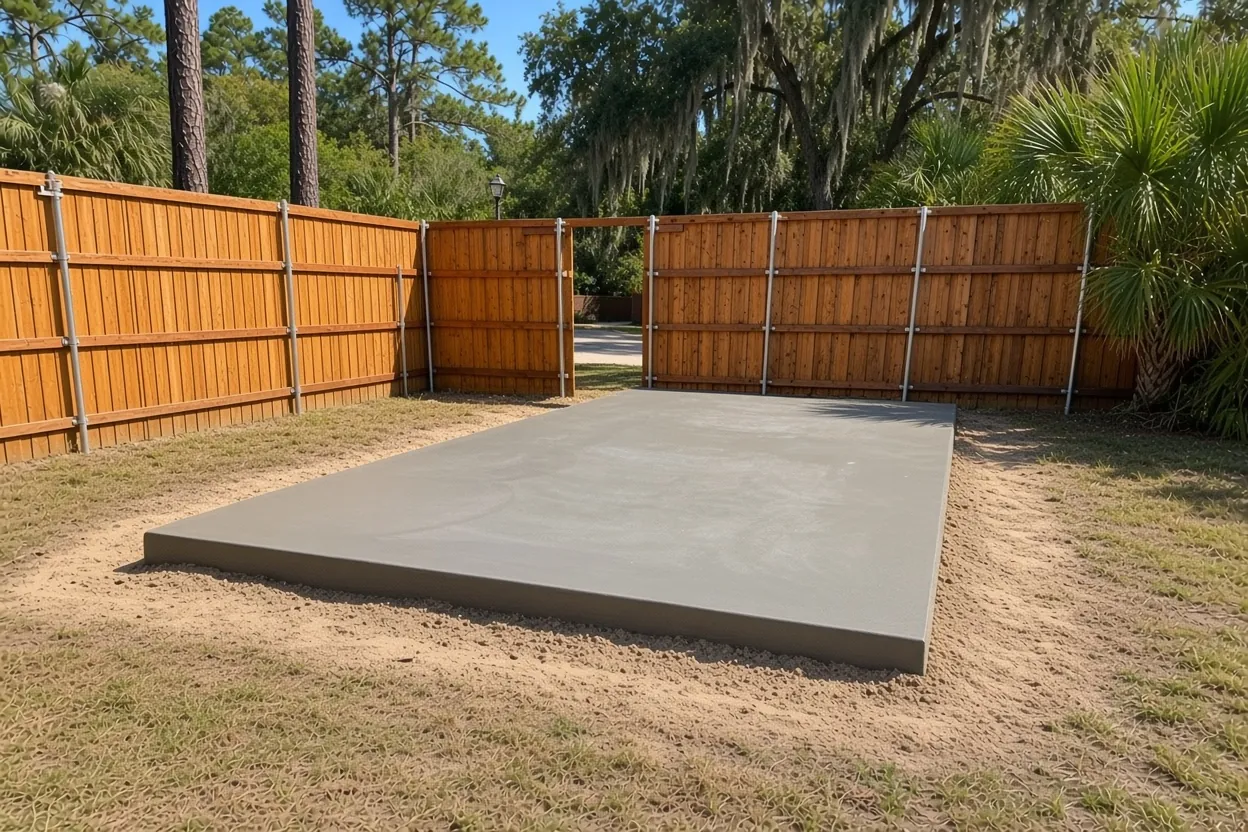
A Winter Haven mailing address, a Polk County shed permit
Look up the county parcel record for a Wahneta yard and the property city will almost always say Winter Haven. Of 1,528 parcels lying wholly inside the Wahneta Census boundary, 1,526 list Winter Haven, one lists Eagle Lake and one lists Wahneta. That label doesn't decide who reviews your shed slab, though. Every point sampled inside the community falls outside all city limits on Polk County's GIS map, so the application goes to the Polk County Building Division in Bartow, not the City of Winter Haven.
The county wants a permit before any accessory structure goes up, and pre-manufactured storage buildings are on that list. The one carve-out is a closet-style box: 5 feet tall, 50 sq ft and 250 cubic feet at most, with no wiring or plumbing. If you can walk into it, you need a permit. Our shed slab page covers the pad county-wide, and the Wahneta slab contractor page covers carports, shops and barns here.
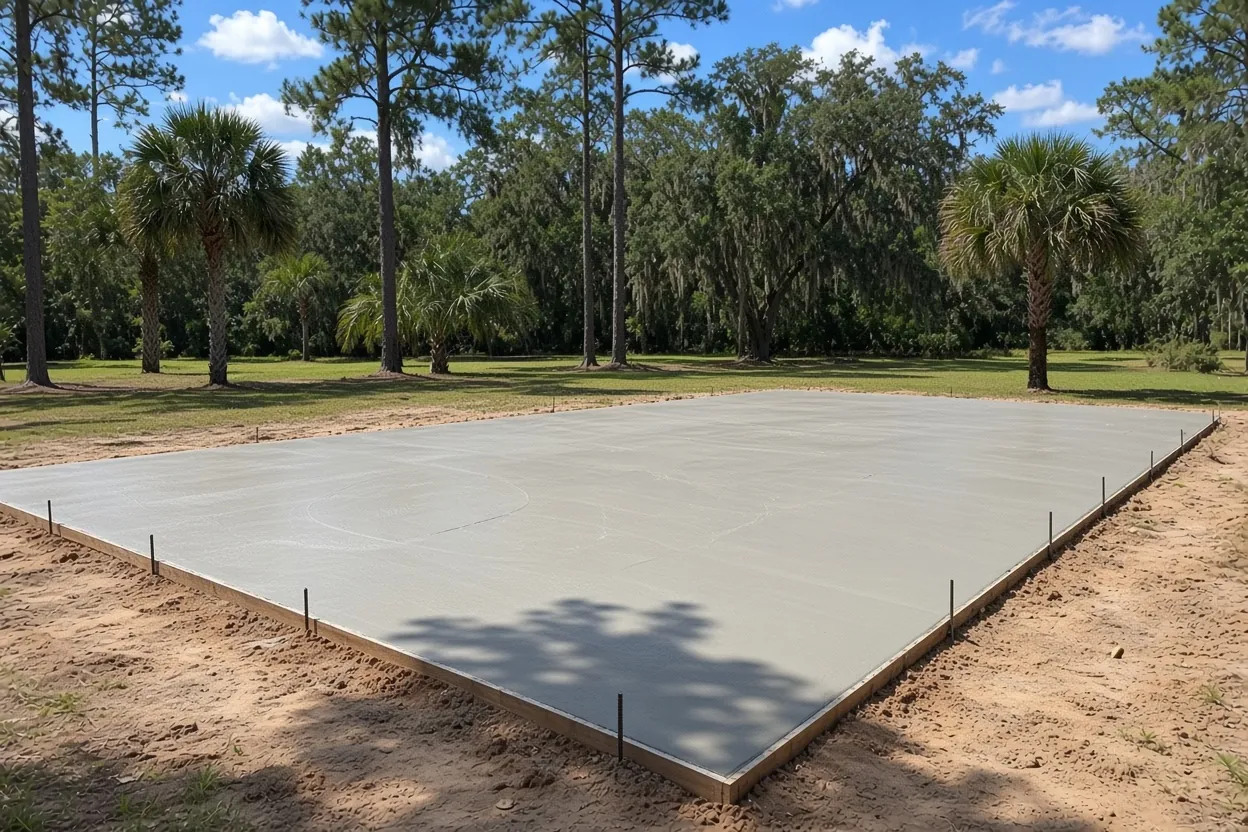
Five feet off the lot line in Wahneta's RSX and RL-1X zones
No other corner of Polk has this rule. Wahneta was the first unincorporated area in the county picked to write its own comprehensive neighborhood plan, and Land Development Code Sec. 403.01 turns that plan into zoning with its own "X" districts. In RSX and RL-1X, the interior side setback drops to 7 feet for the house and 5 feet for an accessory building. The interior rear setback drops to 10 feet for the house and 5 feet for the accessory building.
Plan a storage building around that 5 feet. On a narrow lot, it can decide whether a 12x20 fits behind the house at all. It applies to interior lines, not a street side. It also only helps if your parcel really is in RSX or RL-1X, so don't guess: check the parcel in Polk's land use lookup or ask the Building Division before you order the building. The county also requires every slab to clear setbacks from property lines and easements, so a utility easement along the back fence can still push the pad further in. If your lot is tight, read the Sec. 403.01 text. On the free visit, we'll stake the corners from your survey so you see the footprint on the ground first.
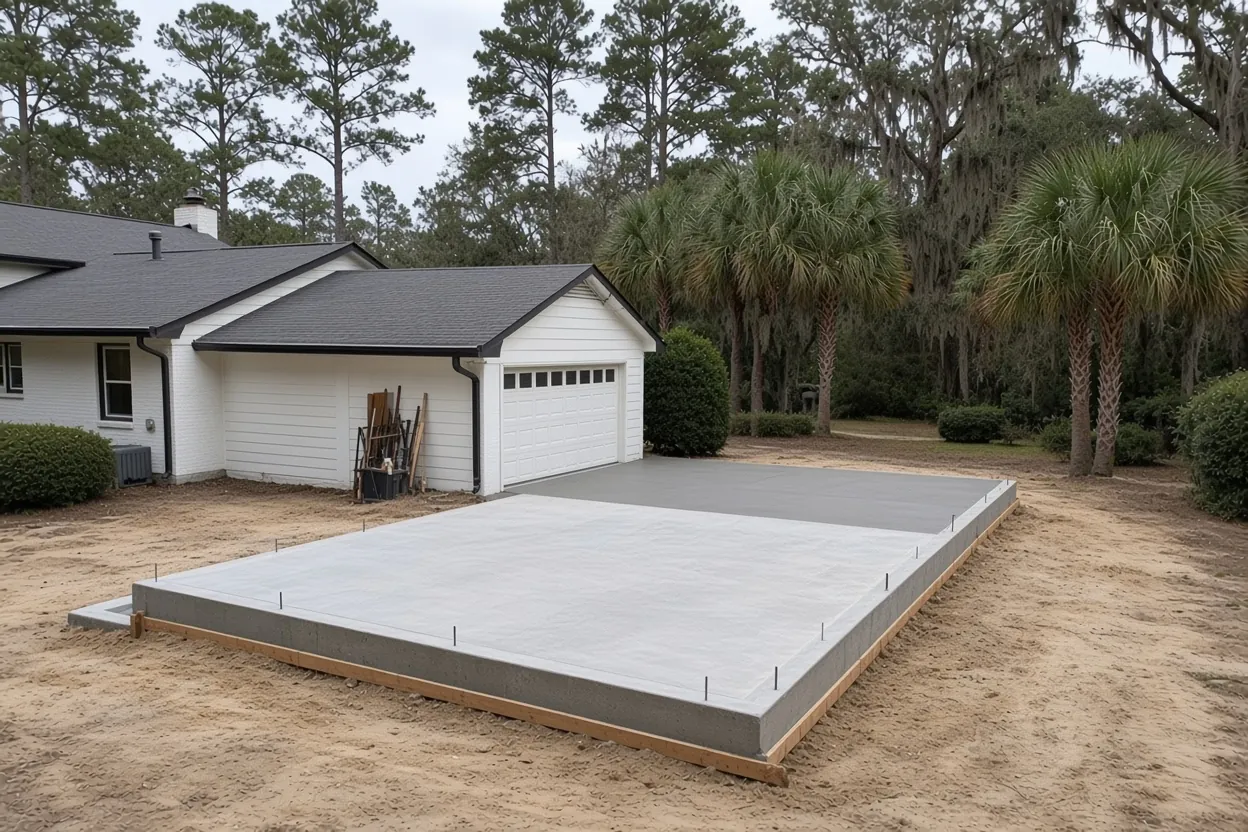
What It Costs
Storage pad ranges for Wahneta lots, before we've seen your yard.
| Job | Per sq ft | Typical project | What moves the price |
|---|---|---|---|
| Shed or storage building slab | $7 to $12 | $1,800 to $5,000 | Pad height over wet sand, fill, anchors, pump access |
| Detached garage or workshop slab | $7 to $12 | $4,500 to $15,000 | Thickness, door apron, vehicle loads |
A 16x20 storage building pad is 320 sq ft, which puts it around $2,240 to $3,840 at our per-foot rate before any extra fill for an AE lot. Treat these as ranges, not a quote. After we see the site, you get a free written estimate within 48 hours of the visit.
The house comes first, and an old trailer can't be the shed
Polk's accessory rules in LDC Sec. 209 apply in Wahneta just as they do across the rest of the unincorporated county. Four of them shape a shed job here.
- A house first. The parcel needs a permitted principal use before an accessory building goes up, unless the building serves bona fide agriculture. There are 147 vacant residential parcels inside the Census boundary, and on any of them the house permit comes before the shed pad.
- Side or rear yard. Sheds go beside or behind the house. Only bona fide agricultural accessory buildings in the A/RR district may sit in any yard.
- No vehicles or mobile homes as storage. Sec. 209.E rules out vehicles, boilers, walk-in freezers and mobile homes as accessory structures. That counts here: the county's housing count for the Wahneta plan found about 60% of homes are mobile homes, and 453 parcels carry a mobile-home land use code. A retired trailer or box van can't stand in for a storage building.
- Bigger lots, bigger buildings. On 2 acres or more, an accessory building can reach 2,000 sq ft or 150% of the house's floor area, whichever is greater, with no variance.
Storing feed or tools for a working farm? Florida's definition of a nonresidential farm building includes a storage building, and our farm building exemption guide walks through that test.
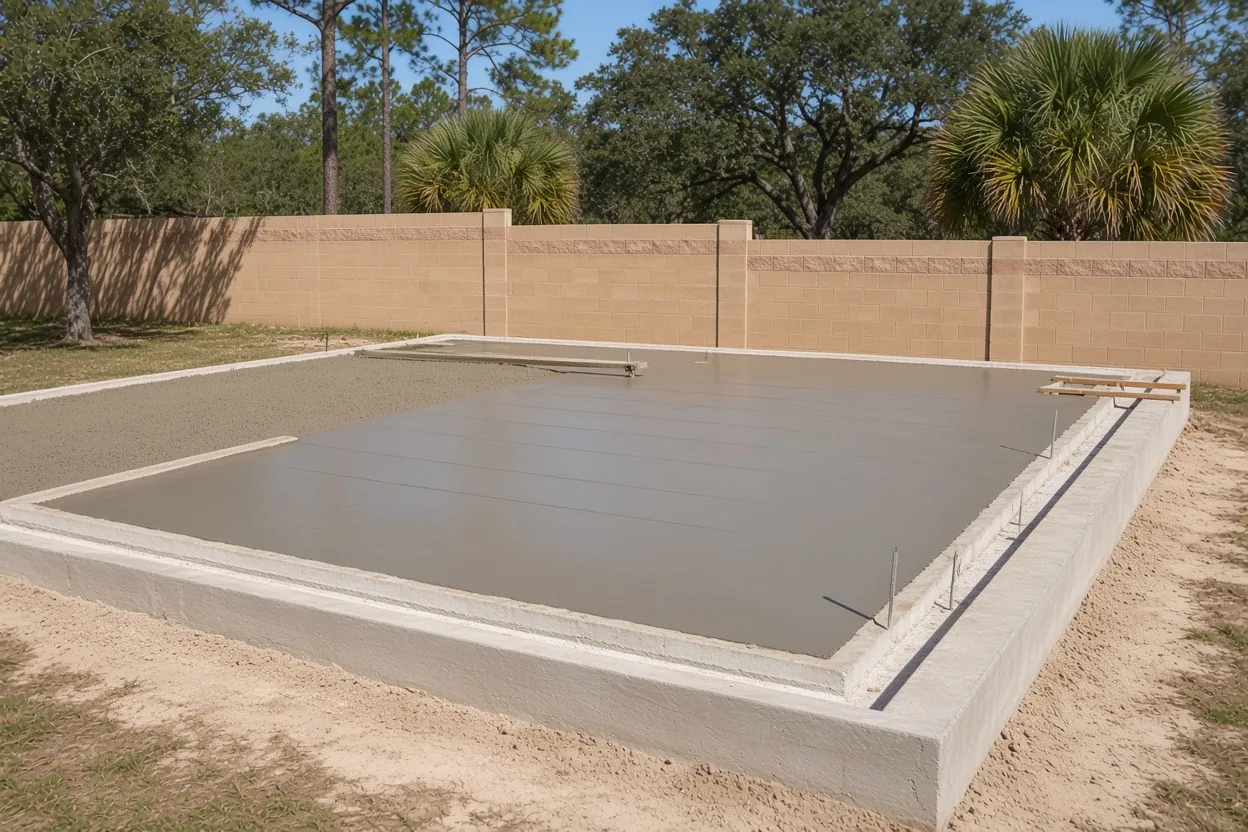
How the Job Goes
Check zoning and setbacks
We go over your survey with you and mark where RSX or RL-1X setbacks and easements put the pad.
Read the wet spots
We note where water sits after rain and set pad height and fill before we price.
Written quote in 48 hours
Fill, forms, anchors and any pump each get their own line.
Form, anchor, pour
Anchors go where the shed drawing puts them. Then we pour, finish, cut and keep the pad damp through the cure.
Pomona and Myakka flatwoods under a Wahneta storage pad
Wahneta's soil sample reads flatwoods, not ridge sand. Pomona fine sand was the most common soil across 45 points sampled inside the community on the NRCS soil map, at 13.3%, followed by Smyrna and Myakka fine sands, the Pomona-urban land complex, Immokalee sand and Ona fine sand. Every one of them is poorly drained, with seasonal high water tables listed at 15 to 31 cm, roughly 6 to 12 inches down. About 78% of the points land on units NRCS rates "very limited" for dwellings without basements. Only St. Lucie fine sand, at 4.4%, rated not limited.
For a shed slab, the pad has to stand above wet sand in July, not sit in it. We strip the vegetation and topsoil inside the forms, as the Florida Building Code requires, then rebuild the grade with clean fill compacted for even support. The code's residential floor section caps fill under a slab at 24 inches of clean sand or gravel unless the building official approves more. Finished grade slopes away from all four edges so rain runs off, not under.
The Wahneta Farms Drainage Canal marks the east edge of the plan area. If your yard backs onto a ditch or holds water after a storm, show us where. We settle pad height before we settle the price.
Zone AE pockets and the Lake Gwyn wetland
Most of Wahneta's sampled ground lies outside the mapped floodplain, but not all of it. At those same 45 points, FEMA's flood layer put 75.6% in Zone X, 17.8% in Zone AE, 4.4% in the AE floodway and 2.2% in the 0.2% annual chance zone. The county says Lake Gwyn, the named lake inside the community, "was a dry lakebed thanks to a depression-era drainage canal" before it was turned into a wetland that sends cleaner water toward the Peace River. Lake Gwyn Park on Avenue A East now has a walking trail and observation pier beside that project.
If your yard falls in an AE zone, find the parcel's base flood elevation before you settle on a building. Polk's flood rule in LDC Sec. 630 sets the lowest floor of new construction, including its mechanical, plumbing and electrical equipment, at least 1 foot above base flood elevation. Sec. 630.N.6 of that code lets a single-story detached storage building up to 600 sq ft rest at grade in a flood zone if it includes flood openings, and the county can tell you whether your shed fits. Ask the Polk County Building Division how that reads for a storage building before the plans are final. On our side, a pad that has to sit higher takes more fill and taller forms, and each one shows up as its own line on the written quote. Start with your address at the FEMA Flood Map Service Center.
Tie-downs on a Wahneta pad and the 720 square foot line
A slab doesn't hold a shed down with its weight. The anchors hold the shed, and the slab holds the anchors. Florida law exempts storage sheds of 720 sq ft or less, not built for people to live in, from the wind-borne debris impact standards. That's why the doors on a small prefab building don't need impact ratings. Wind load is another matter, and the exemption doesn't touch it. The design wind speed comes from the Florida Building Code wind maps for the building's risk category, and it belongs on the shed maker's engineered drawing or your engineer's plan, along with the anchor type and spacing.
We follow that drawing to the letter. If it calls for anchors cast into the pour, they're set in the forms before the truck pulls up. If it calls for anchors drilled in later, we keep saw cuts away from those spots so every bolt lands in solid concrete. Hurricane season runs June 1 to November 30 and peaks around September 10. A building delivered in late summer should get tied down the week it arrives, not after the first storm watch. For larger post-frame storage, see the Wahneta pole barn slab page.
Thickness, saw cuts and curing for a 12x16 or larger pad
The Florida Building Code sets 3 1/2 inches as the minimum for a slab-on-ground floor, and residential slabs run about 4 inches. For a shed holding a riding mower, bikes and shelving, we start at 4 inches over compacted fill; a shop with a lift or heavy benches gets whatever its drawing calls for. The code accepts two kinds of crack control: synthetic fibers, or 6x6 W1.4xW1.4 welded wire in the middle to upper third of the slab. Either one lets you skip contraction joints, as long as random cracking doesn't bother you.
Prefer clean joints? NRMCA's joint spacing guide spaces them 24 to 36 times the thickness, so 8 to 12 feet on a 4 inch pad, with panels close to square. On a 12x16 pad, that means one cut across the middle, leaving two 12x8 panels. The code doesn't require a 6-mil vapor sheet under unheated accessory buildings, so adding one is your call, and we price it either way. Curing runs 3 to 7 days, and concrete that dries out early can lose as much as half its potential strength. We keep the pad damp and covered between the summer storms that run from late May to early October.
Parcel ID, shed drawing and yard photos for the estimate
- Your parcel ID, so you can confirm the county record and the zoning district (RSX or RL-1X matters for the 5-foot setback).
- A survey or site plan showing lot lines and any easement along the back or side.
- The shed maker's engineered drawing with footprint, height and anchor layout.
- Photos of the spot after a hard rain, plus any nearby ditch, canal edge or low corner.
- Gate width and the route a mixer or pump hose would take to the back yard.
- If the job tops $2,500, Florida requires a recorded Notice of Commencement (s. 713.13 with s. 713.02(5)), so build that into the timeline.
Then book the free on-site estimate or call (863) 269-3083. We also pour shed pads in Winter Haven, Lakeland and Lake Wales.
Questions We Get
My Wahneta deed says Winter Haven. Does the city permit my shed?
Can my Wahneta shed sit 5 feet from the back fence?
How much wider than the building should a Wahneta shed pad be?
Can a shed on my Wahneta lot be tied down for hurricanes?
Can I use an old travel trailer as a storage shed in Wahneta?
My yard near Lake Gwyn floods. Can I still put a shed there?
Sources we used
- Building Permitting, Polk County Building Division
- LDC Section 403.01 Wahneta Neighborhood Plan, Polk County (Municode)
- LDC Section 209 Accessory Structures, Polk County (Municode)
- LDC Section 630 Flood Hazard Management, Polk County (Municode)
- Comprehensive Plan Section 2.134-A Wahneta Neighborhood Plan, Polk County (Municode)
- Lake Gwyn Park, Polk County
- 2023 Florida Building Code, Residential, Chapter 5 Floors, ICC / Florida Building Commission (via UpCodes)
- Florida Statutes s. 553.73 Florida Building Code, Florida Legislature (Online Sunshine)