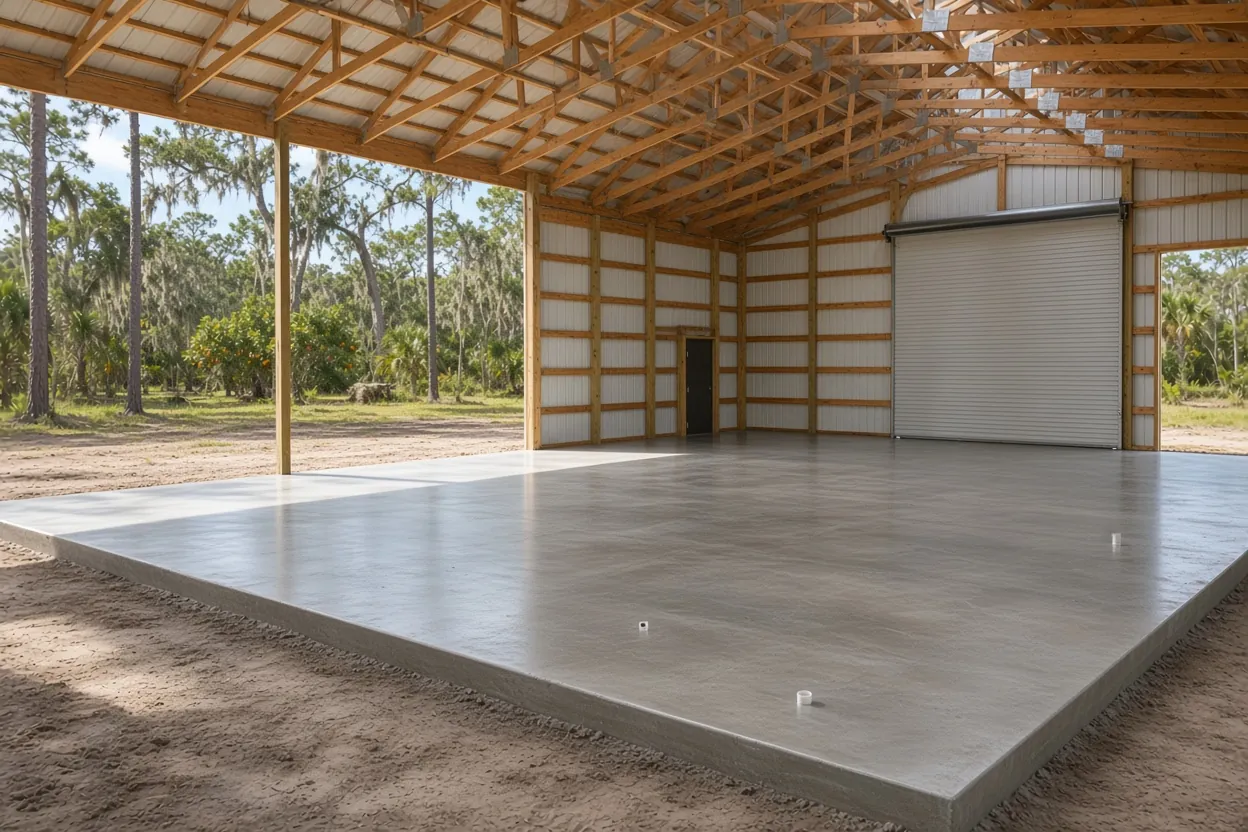
Finished floor height and ISR math on the Lake Alfred site plan
The City of Lake Alfred's building permit page, run by Community Development on Lake Shore Way, lists what new home construction needs, and a barndominium counts as one. Along with sealed plans from a Florida architect or engineer, Product Approval codes and energy calculations, the site plan must show setbacks, impervious surface (ISR) calculations and the Finished Floor Elevation.
Two of those land straight on the barndominium foundation. The finished floor number tells us how high the slab sits, which sets how much fill the pad needs and whether the edges get deeper. The ISR math counts every hard surface, so a wide slab with a shop apron and a long driveway uses up more of the lot's allowance than the house alone. Get both numbers from your designer before you ask for a firm price. Our barndominium foundations page explains how we build these floors across Polk County.
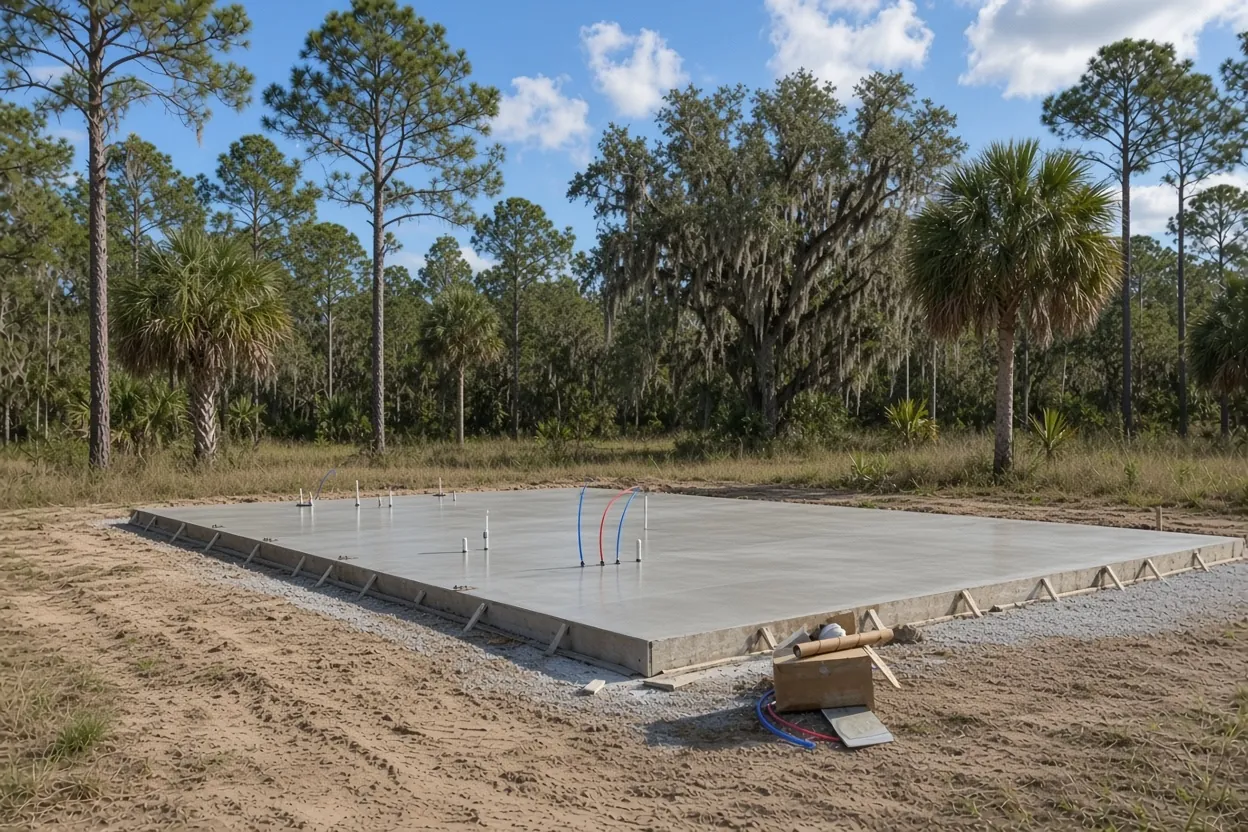
Bedded rows and filled ditches under a former grove lot
Lake Alfred is home to the UF/IFAS Citrus Research and Education Center on Experiment Station Road, and oranges are Polk County's largest crop by acreage in the 2022 Census of Agriculture. So the lot you bought for a barndo may be former grove ground, and grove ground was shaped for trees, not houses.
UF/IFAS notes that flatwoods citrus sites were often leveled, bedded and ditched for drainage, and that many flatwoods soils hold a layer that perches the water table. On a building pad, old beds and filled ditches mean the soil under one corner can be softer than the soil under another. We probe the pad and look for the old row pattern before we price fill.
Fill under a house slab has limits. The residential code caps it at 24 inches of clean sand or gravel unless the building official approves more, so a low lot that needs a big lift can mean a stem wall instead of a monolithic slab. Pull your parcel on the NRCS Web Soil Survey and tell us if the lot was a grove. A barndo on grove land is still a house, never a farm-exempt barn; our farm building exemption guide explains where that line sits.
What It Costs
Our range for a Lake Alfred barndominium foundation. Fill to your finished floor height moves it most.
| Job | Per sq ft | Typical project | What moves the price |
|---|---|---|---|
| Barndominium monolithic foundation | $10 to $16 | $20,000 to $40,000+ | Fill height, grove soft spots, edge length, sleeves |
| Monolithic house slab | $8 to $15 | $16,000 to $45,000+ | Footprint, footing depth, fill |
Our ranges, not a quote. The real number comes in a free written estimate after we see the lot and the site plan.
A utility account before the first Lake Alfred inspection
Put this on the list early. Lake Alfred says that for new construction, a utility account must be set up for the property, through the city's New Service Application, before any inspection is conducted. The under-slab plumbing and slab inspections come first on a barndominium, so the application has to be in before the pad is ready, not after.
Two more power steps come later. To get a Government Power Release, the city asks for the provider's work order number, the address and the permit number by email. Certificates of Completion and Occupancy are also requested by email. Neither touches the slab, but both depend on the same permit file, so keep the permit number handy from the start.
Our part: we won't schedule the pour until the permit holder confirms the utility account is open. A pad that is treated, covered and steeled with no account behind it just sits waiting, and treated soil exposed to rain has to be treated again.
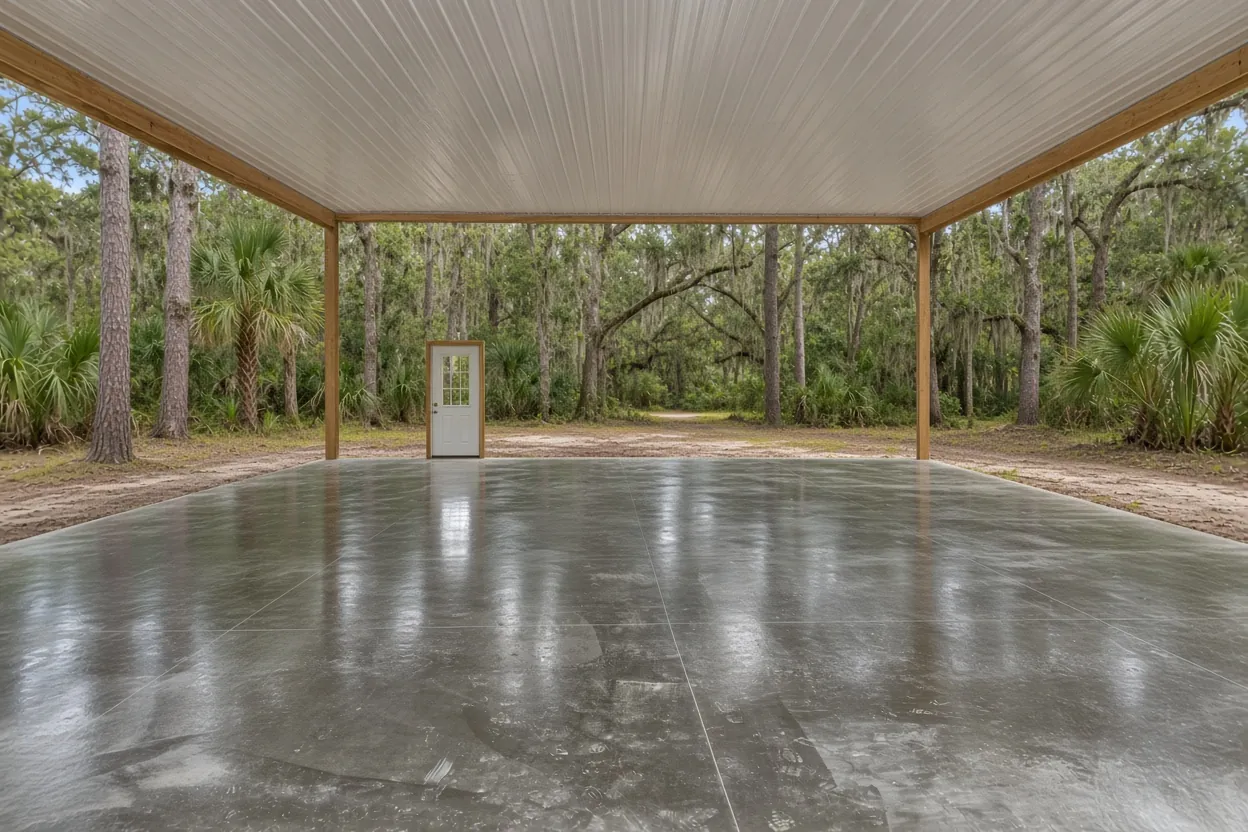
How the Job Goes
Site plan first
We read the finished floor height and ISR numbers, then walk the Lake Alfred lot.
Written estimate
Fill, edges and sleeves are listed line by line, so a lower floor height shows its savings.
Utility account check
The permit holder confirms the city utility account is open before we book the pad work.
Treat, cover, inspect
Rough-in, termite treatment, poly and steel go in; the inspection is requested by 2 pm the day before.
Pour and cure
We pour after the pass, finish and cure, then tell your framer when to start.
Next-day inspections and a covered, treated pad
Lake Alfred doesn't do same-day inspections. Requests have to be in by 2 pm for the next day. That cutoff sets the timing of the last two days before a barndo pour.
Here is the order we work in. Your plumber sets the under-slab rough-in. The pest control company treats the soil inside the foundation and issues its certificate to the building department. The 6-mil poly goes over the treated soil right away, then steel, sleeves and anchor hardware. The permit holder then requests the inspection before the 2 pm cutoff, and we book the concrete for the morning after a pass.
If storms are forecast for the inspection day, we hold the poly and treatment schedule back rather than leave a treated pad open. The code says rain on treated soil before the poly is down means retreating it, and a missed inspection day pushes everything by at least one day. The full sequence is in our barndominium foundation guide.
Who signs, and the notice posted on a Lake Alfred job
Lake Alfred takes applications from a contractor whose state license is registered in the city's Accela system, or from the owner of homesteaded property acting as their own contractor with the Owner Builder Affidavit. If your barndo is going on a bare lot you don't live on yet, ask Community Development whether the parcel qualifies before you plan to file it yourself. A contractor filing needs an Owner Application Authorization from you.
The Notice of Commencement is recorded with the Polk County Clerk of Courts, and the city wants a certified copy, or a notarized statement that it was filed, posted at the job site and attached to the application. The city's page prints a $5,000 threshold. Florida's lien law sets the recording line lower: improvements over $2,500 (s. 713.13, read with s. 713.02(5)). A barndominium foundation clears both numbers, so plan on recording one.
Lake Alfred barndo budget: our slab and the city's fees
Our barndominium foundation range is $10 to $16 per sq ft for a monolithic slab with thickened edges and plumbing and electrical rough-in sleeves, with typical projects at $20,000 to $40,000 and up. A 40 by 55 shell is 2,200 sq ft, so $22,000 to $35,200. What moves it inside the range:
- Fill to reach the finished floor height on the site plan.
- Extra work on soft rows or filled ditches from an old grove.
- Edge length, since thickened edges cost more per foot than the field.
- Sleeve count on the living side.
The city's charges sit outside our number. Lake Alfred posts its permit fees in Ordinance 1542-24 and a separate impact fee sheet, and Community Development will give you an estimated cost by phone or email. Ask before you set a total budget.
Lake Alfred file we ask to see before pricing
- The site plan with setbacks, ISR math and the Finished Floor Elevation.
- The sealed foundation sheet and floor plan.
- Your plumber's rough-in layout.
- Whether the parcel was a grove, and any soil report.
- Who files: you as homestead owner-builder, or your contractor.
- Status of the city utility account.
Send what you have through the free estimate page. If a steel shop or a farm barn shares the parcel, see the Lake Alfred steel building foundation and pole barn slabs in Lake Alfred, and the Lake Alfred town page covers the city's other slab rules. Neighbors in Winter Haven, Auburndale and Haines City have their own pages.
Questions We Get
Where does the finished floor height for a Lake Alfred barndo come from?
Do old grove beds under a Lake Alfred lot change the barndo pad?
Does a bare lot in Lake Alfred let me pull my own barndo permit?
What has to be posted at a Lake Alfred barndominium job site?
How do I get power turned on at a new Lake Alfred barndominium?
Are Lake Alfred's impact fees part of your foundation price?
Sources we used
- Building Permits, City of Lake Alfred
- Citrus Research and Education Center, UF/IFAS
- Nutrition of Florida Citrus Trees, Ch. 2 (SL456/SS669), UF/IFAS Extension (EDIS)
- 2022 Census of Agriculture County Profile: Polk County, Florida, USDA NASS
- Florida Statutes s. 713.13 Notice of commencement, Florida Legislature (Online Sunshine)
- Florida Statutes s. 713.02 Types of lienors and exemptions, Florida Legislature (Online Sunshine)
- 2023 Florida Building Code, Residential, R506 Floors, ICC / Florida Building Commission (via UpCodes)
- 2023 Florida Building Code, Building, Section 1816 Termite Protection, ICC / Florida Building Commission (via UpCodes)